Looking For The Right Blade To Cut Laminate Countertops? This guide compares top circular saw blades suited for laminate countertop work, focusing on clean cuts, anti-chip performance, and durability. Below is a quick comparison of the selected blades to help you scan options fast.
| Product | Best For | Key Feature |
|---|---|---|
| WEN BL0704 7-1/4-Inch Diamond-Tipped | Fiber Cement & Laminate | Ultra-thin 1/15″ kerf, PCD tips |
| Diablo Track 6-1/2″ 52T | Track/Precision Cuts | TiCo Hi-Density Carbide, TCG teeth |
| CRAFTSMAN 7-1/4″ 140T Fine Finish | Fine Finish Crosscuts | Precision-ground teeth, hardened plate |
| FOXBC 7-1/4″ 140T Fine Finish (3-Pack) | Frequent Jobs/Multiple Blades | 0.086″ kerf, 140 teeth |
| DEWALT 6-1/2″ 90T Vinyl Cutting | Thin Materials & Vinyl | Tungsten carbide teeth, anti-stick coating |
WEN BL0704 7-1/4-Inch Diamond-Tipped Blade
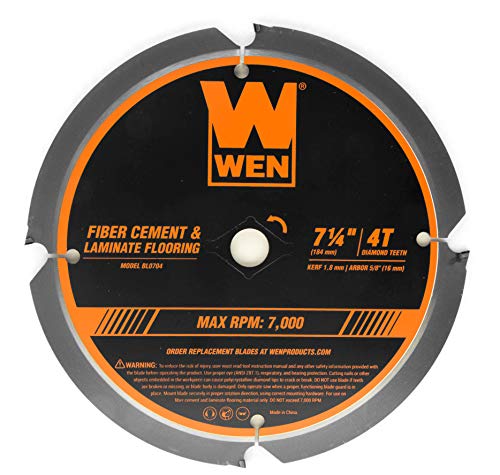
Designed For slicing through fiber cement board and laminate flooring. The blade features a 7-1/4-inch diameter with a 5/8-inch arbor and a rating up to 7000 RPM. It uses diamond-tipped (PCD) cutting surfaces intended for hard, abrasive materials.
Key Performance Notes: Ultra-thin 1/15-inch (≈1.8mm) kerf promotes less material waste and reduced tear-out. The PCD tips maintain sharpness longer on abrasive laminate surfaces. Use with steady feed and proper support to reduce vibration for the cleanest edge.
Diablo Track Circular Saw Blade For Laminate

Designed For track saws and precision work where straight, chip-free cuts matter. This 6-1/2″ blade has 52 teeth and a maximum RPM of 8,800. It uses TiCo Hi-Density Carbide and Triple Chip Grind (TCG) geometry for consistent edges.
Key Performance Notes: The 1.8mm laser-cut kerf balances rigidity and low waste for guided cuts. TCG tooth geometry reduces chipping on laminated surfaces and composite materials, making it a solid choice for installers and finish carpenters using a track system.
CRAFTSMAN 7-1/4 Inch 140 Tooth Fine Finish Blade

Designed For ultra-fine crosscuts in plywood, OSB, plastics, and laminate surfaces. The fully-hardened plate helps maintain trueness while precision-ground teeth aim to reduce splintering on delicate surfaces.
Key Performance Notes: High tooth count (140T) offers very fine, smooth edges on laminate countertop cuts, especially when using zero-clearance inserts or masking tape to further prevent chipping. Heavy-gauge carbon steel plate increases stability under load.
FOXBC 7-1/4 Inch 140 Tooth Fine Finish (3-Pack)
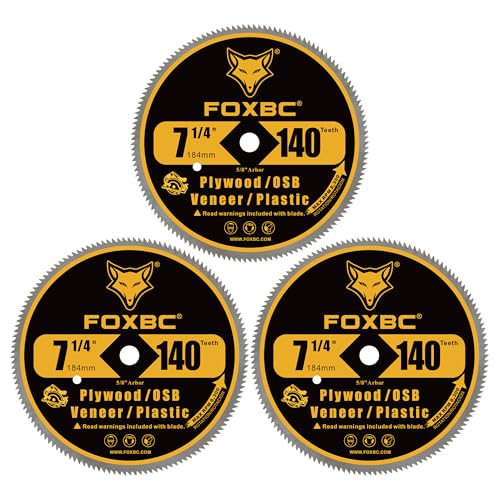
Designed For repeat jobs where multiple blades are needed. Each 7-1/4″ blade has 140 teeth, a 5/8″ arbor, and a 0.086″ kerf for fine finish cutting of plywood, vinyl, veneer, and laminates.
Key Performance Notes: The high tooth count and thin kerf are optimized for minimizing splintering and producing smooth miter and crosscut edges. A 3-pack provides backup blades for continuous work or to dedicate blades to different materials to avoid cross-contamination of sawdust and adhesive residues.
DEWALT 6-1/2 Inch 90 Tooth Vinyl Cutting Blade

Designed For cutting vinyl, vinyl-backed laminates and other thin surfacing materials where a smooth, non-gumming cut is needed. Contains tougher tungsten carbide tips and an anti-stick coating to reduce friction and pitch buildup.
Key Performance Notes: The thin kerf and high tooth count (90T for 6-1/2″) make it well-suited for handheld saws cutting countertop overhangs or trim pieces. Anti-stick coating supports longer life when cutting adhesive-backed laminate.
Buying Guide: Choosing A Blade For Laminate Countertops
Tooth Count And Geometry — Higher tooth counts (80–140T equivalent for 7-1/4″ blades) produce smoother cuts and less chipping on laminate. Tooth geometry matters: Triple Chip Grind (TCG) and Alternating Top Bevel (ATB) designs reduce tear-out; TCG is excellent for abrasive composites.
Kerf Thickness — Thin kerfs (≈0.08–1.8mm range depending on blade type) reduce waste and require less power. Stiffer blades with slightly thicker kerfs can run truer for long straight cuts, especially on track saws.
Tip Material — Tungsten carbide is standard for laminate work; PCD (diamond-tipped) offers extended life on very abrasive materials but can be overkill for thin decorative laminates. Match tip material to workload and abrasiveness.
Blade Diameter & Arbor Fit — Confirm your saw’s diameter and arbor size. Common homeowner saws use 7-1/4″ with a 5/8″ arbor. Track saws or specialty saws may use different sizes like 6-1/2″. Use correct adapters if provided by the manufacturer.
Anti-Chip Measures — Use blades with anti-chip tooth geometry and combine with prep techniques: apply painter’s tape over cut lines, use zero-clearance inserts, and cut with the finished face up or down depending on saw type to minimize visible chipping.
Coating & Maintenance — Anti-stick coatings reduce gum-up from adhesives. Keep blades clean of resin and pitch; a clean blade cuts cooler and smoother. Replace or sharpen blades as soon as finish quality drops.
Cutting Setup — Support the countertop to prevent tear-out from sagging, clamp workpieces, and consider a track saw or guide for straight cuts. Make test cuts on scrap to confirm blade selection and machine settings before cutting finished material.
Durability & Cost Trade-Off — Higher-end blades with carbide or PCD tips last longer under heavy use. For occasional countertop trimming, fine-tooth carbide blades usually balance cost and finish. For repeated jobs or abrasive substrates, consider carbide-tipped or PCD options.
Comparison Perspectives — Evaluate blades by: finish quality (chip-free edges), longevity (tip material & tooth geometry), compatibility (diameter & arbor), and workflow (single blade vs multi-pack). Prioritize the factor that best matches your frequency of work and material type.