Choosing The Right Heat Sink Material affects thermal performance, durability, and installation for electronics, sinks, and power components. Below is a concise comparison table for the selected products, followed by focused product sections and a buying guide to help you evaluate materials such as aluminum, silicone thermal pads, metal compounds, and specialty stonecast for heat-resistant fixtures.
| Product | Material / Type | Key Feature |
|---|---|---|
| MEETOOT Thermal Conductive Silicone Pad | Thermally Conductive Silicone | Soft, Insulating, Gap-Filling |
| CGELE Aluminum Heat Sink SSR | Aluminum | Solid Block Radiator For SSRs |
| M.2 Heatsink Cooler 2280 SSD | Aluminum Alloy With Thermal Pads | Compact SSD Cooling, Silver Plating |
| Walfront Large Aluminum Heat Sink | Extruded Aluminum Finned | High Surface Area Cooling Fins |
| Super Lube Silicone Heat Sink Compound | Thermally Conductive Paste (Silicone + Metal Oxides) | High Heat Transfer, Non-hardening |
MEETOOT 2PCS Heat Sink Thermal Conductive Silicone Pad

This thermally conductive silicone rubber sheet is sized 100 x 100 x 1 mm and designed to fill gaps between heat-generating components and heatsinks. Features include electrical insulation, soft conformability, and the ability to be cut to fit. The material resists temperatures from -40°C to 200°C, is non-toxic, flame-retardant, and anti-static.
Use Cases: bridging uneven surfaces, protecting metal contact areas, and improving thermal coupling where mechanical compression is limited. Benefits include easy installation and electrical isolation compared to conductive greases.
CGELE Aluminum Heat Sink SSR Radiator

This aluminum heat sink is specified for solid state relays (10A–40A) and is offered in a black anodized finish. The design focuses on compact heat spreading for industrial and electrical applications. Aluminum provides good thermal conductivity while keeping weight and cost low.
Use Cases: mounting to SSRs, power modules, and compact electronics where passive dissipation is required. Aluminum is effective for many electronics because of its balance of conductivity, weight, machinability, and corrosion resistance when anodized.
M.2 Heatsink Cooler 2280 SSD Double-Sided Heat Sink
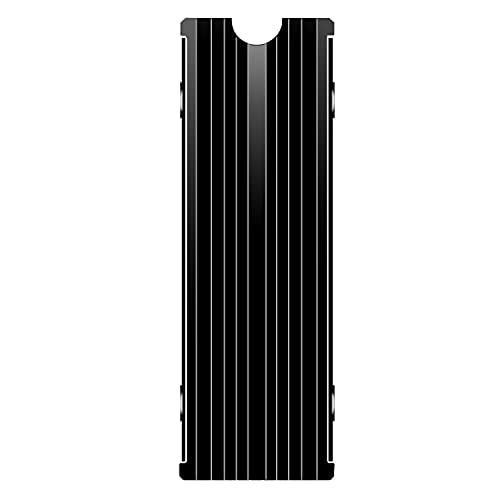
This compact aluminum alloy heatsink with silver plating and anodic oxidation is tailored for M.2 SSDs and PS5 installation. It includes thermal pads with low viscosity to avoid mechanical damage to delicate surfaces. The silver plating helps with static dissipation and the anodized surface increases wear resistance.
Use Cases: cooling NVMe M.2 modules in tight spaces. Aluminum alloys are often used here for high surface-area designs and ease of machining into low-profile heatsinks combined with thermal pads to compensate for uneven surfaces.
4Pcs Aluminum Heat Sink Large Finned Cooler

This extruded aluminum fin heat sink emphasizes increased surface area through slotted fine teeth to improve convective cooling. Typical applications include chips, power ICs, and modules that benefit from passive airflow. Aluminum extrusions are common due to consistent thermal performance and lower cost compared to copper.
Use Cases: DIY electronics, stepper motors, TEC modules, and boards where attaching larger fins aids airflow-driven cooling. Pre-machined fins are ideal when forced convection or natural convection is available.
Super Lube 98003 Silicone Heat Sink Compound

This thermally conductive silicone grease is blended with fine metal oxide powders to remain stable without hardening, drying, or melting. It is designed to improve heat transfer between CPUs or heat sources and heatsinks while avoiding accelerated oxidation or carbonization of components.
Use Cases: filling microscopic surface irregularities where maximum conductive contact is required. Thermal paste typically provides lower thermal resistance than pads but requires careful application and may need reapplication over long service intervals.
Buying Guide: Choosing The Best Heat Sink Material
Selecting a heat sink material depends on thermal performance needs, mechanical constraints, electrical isolation, weight, cost, and environment. Below are key considerations and comparison viewpoints.
Thermal Conductivity
- Copper – Highest conductivity among common metals; excellent for compact, high-heat applications but heavier and costlier.
- Aluminum – Widely used: good conductivity, lightweight, inexpensive, easy to extrude or machine for fins and blocks.
- Silicone Pads & Grease – Not structural heatsink materials but improve interface heat transfer and electrical isolation. Grease usually has lower thermal resistance than pads but lacks electrical insulation.
Mechanical & Installation Factors
- Extruded or machined aluminum heatsinks attach easily with clips, screws, or adhesive tapes and are suitable where airflow exists.
- Solid-block aluminum or copper suits direct mounting on power modules and relays for conduction-dominant designs.
- Thermal pads (silicone) are ideal when gaps or movement exist; thermal paste is best for fixed, flat contact surfaces.
Electrical Isolation & Safety
- If electrical insulation is required between a component and heatsink, thermally conductive silicone pads provide insulation and gap filling.
- Thermal greases typically are not electrically insulating and should be avoided where shorting is a risk unless specified non-conductive.
Durability & Environment
- Choose anodized aluminum or plated surfaces in humid or corrosive environments.
- High-temperature tolerance and flame-retardant ratings matter for automotive or industrial uses; silicone-based pads often have broad operating ranges.
- Consider vibration and thermal cycling: pads and adhesives can absorb movement, while rigid mounts may require mechanical fasteners and anti-vibration design.
Form Factor & Surface Area
- Finned extrusions increase convective cooling; more surface area improves heat rejection in air-cooled systems.
- For limited space, high-conductivity metals (copper or dense aluminum alloys) paired with forced-air solutions or heat pipes can achieve required dissipation.
Thermal Interface Material (TIM) Choice
- Use thermal paste/compound when you need minimal thermal resistance and permanent, thin interfaces.
- Use thermal pads when you need electrical isolation, easy replacement, or to bridge larger gaps.
- Match TIM thickness and compressibility to surface flatness and clamping pressure to ensure optimal contact.
Cost vs Performance Tradeoffs
- Aluminum offers the best overall cost-to-performance for most electronics and extruded fin designs.
- Copper is reserved where thermal performance must be maximized in compact designs.
- Specialty materials (stonecast for sinks) integrate heat resistance with aesthetics and are chosen for specific appliance or structural needs.
When specifying a heatsink system, evaluate the thermal load (watts), allowable temperature rise, available space, airflow conditions, and whether electrical insulation is required. Combine an appropriate bulk heatsink material with a matching TIM to meet thermal and mechanical constraints.