Quick Summary: This guide compares top reciprocating saw blades designed to cut cast iron pipe and other abrasive metals. Below is a compact product table to help you compare options at a glance.
| Product | Blade Type | Best For |
|---|---|---|
| HARDWIN Carbide 6″ 8TPI (3-Pack) | Carbide-Tipped | Thick cast iron, alloy steel, long life |
| BOSCH RCB9DG 9″ Diamond Grit | Diamond Grit | Highly abrasive materials, cast iron, masonry |
| Diablo DS0930DGX 9″ Diamond Grit | Diamond Grit | Fast cuts, extended life on cast iron and masonry |
| EZARC R978HM 9″ 8TPI Carbide (3-Pack) | Carbide-Tipped | Thick metal, hardened steel, cast iron |
| Diablo DS0608CF3 6″ Carbide Teeth 3 TPI (3-Pack) | Carbide Tooth, Low TPI | Extreme metal removal, thick cast iron sections |
HARDWIN Carbide Reciprocating Saw Blade, 6-Inch 8 TPI – 3-Pack

This carbide-tipped blade set is built for prolonged cutting of hard metals including cast iron and alloy steel. The 8 TPI configuration targets medium-to-thick metals and balances cutting speed with tooth durability.
- Carbide Teeth Lifespan: Claims up to 30x longer life than standard bi-metal blades.
- Tooth Design: 8 TPI with an anti-binding wavy profile to reduce vibration and binding in thicker sections.
- Construction: Precision-milled, individually welded teeth for consistent burr-free cuts.
- Use Case: Best for repeated through-cuts on cast iron pipe sections 3/16″–1/2″ and similar materials.
BOSCH RCB9DG 9″ Diamond-Grit Edge Reciprocating Saw Blade

This vacuum-brazed diamond-grit blade is optimized for abrasive materials such as cast iron, cinder block, and brick. Diamond grit blades wear differently than carbide and excel on abrasive surfaces.
- Cutting Edge: Diamond grit for high abrasion resistance against cast iron and masonry.
- Durability & Speed: Marketed as faster and longer-lasting than carbide-grit blades for heavy use.
- Use Case: Ideal when cutting cast iron that also contains scale, rust, or when transitioning between metal and masonry.
Diablo 9″ Diamond Grit Reciprocating Saw Blade DS0930DGX

Diablo’s diamond grit blade emphasizes a thin kerf and a coated body to resist heat and corrosion. It’s tailored for prolonged, controlled cutting of cast iron while maintaining blade life.
- Extended Life: Up to 6x life compared with standard blades for abrasive tasks.
- Thin Kerf: Improves cutting speed and reduces required power, useful for reciprocating saws with lower stroke force.
- Coating: Perma-Shield resists heat buildup and corrosion for consistent performance.
- Use Case: When you need cleaner cuts and longer wear on abrasive cast iron pipe or masonry-adjacent work.
EZARC Carbide Reciprocating Saw Blade R978HM 9″ 8TPI – 3-Pack
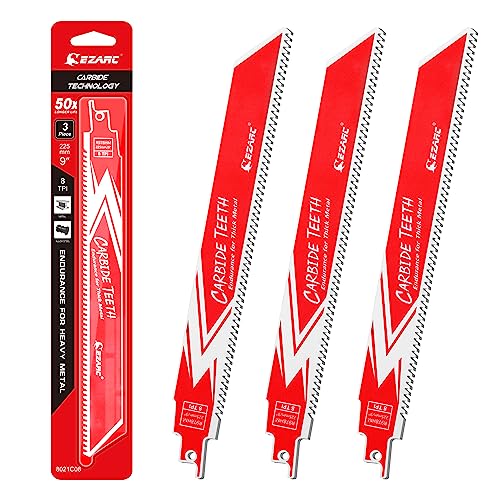
EZARC offers a carbide technology blade claiming up to 50x longer life than bi-metal alternatives. The 8 TPI tooth spacing is intended for robust metal cutting including hardened and high-alloy steels.
- Carbide Technology: Designed for endurance on hardened and abrasive metals like cast iron.
- Tooth Pitch: 8 TPI for balanced material removal and tooth longevity on thick sections.
- Use Case: Projects involving repeated cuts through cast iron pipe or when cutting different metal types in the same job.
Diablo Steel Demon Carbide Teeth 6″ 3 TPI – 3-Pack

This low TPI carbide-tooth blade is engineered for extreme metal cutting and rapid material removal. The 3 TPI aggressive tooth spacing favors fast, deep cuts in thicker cast iron sections.
- Carbide Teeth: High-performance carbide for durability in thick metals from 3/16″ to 9/16″.
- Low TPI Design: 3 TPI focused on aggressive material removal rather than fine finish.
- Use Case: Best for demolition-style cuts or when cutting through very thick cast iron pipe where speed is a priority.
Buying Guide: How To Choose A Blade For Cast Iron Pipe
Cutting cast iron pipes requires blades that resist abrasion and heat while maintaining tooth integrity. Consider these factors when selecting a reciprocating saw blade.
Blade Material
- Diamond Grit: Excellent for abrasive materials and cast iron with scale or masonry contact. Wears gradually rather than chipping; good for mixed-material jobs.
- Carbide-Tipped/Carbide Teeth: Superior life and toughness on hardened metals and repeated cuts. Best for thicker cast iron where teeth must stay sharp under heavy load.
- Bi-Metal: More affordable and flexible but wears faster on abrasive cast iron; suitable for occasional light-duty tasks.
Tooth Pitch (TPI)
- Low TPI (3–6): Aggressive removal, faster cuts, rougher finish. Good for thick pipe or demolition.
- Medium TPI (8–14): Balances speed and smoother cuts—useful for standard cast iron pipe removal and when you want reduced binding.
- High TPI (>14): Slower, finer cuts; generally not ideal for thick cast iron but can help on thin-walled pipe or when minimizing vibration.
Blade Length And Kerf
- Length: Choose a length that reaches fully through the pipe or allows plunge cuts without changing blades frequently.
- Kerf: Thin kerf blades cut faster and reduce load on the saw but may be less robust under heavy abuse.
Durability And Coating
- Coatings: Heat- and corrosion-resistant coatings (e.g., Perma-Shield) extend blade life under high-heat cutting conditions.
- Construction Quality: Look for precision-welded teeth and reinforced bodies to resist breakage and vibration.
Cutting Conditions And Saw Compatibility
- Abrasive Content: If pipe is heavily corroded, scaled, or cement-lined, diamond-grit edges often last longer.
- Saw Power & Stroke: Aggressive low-TPI blades need higher stroke force; ensure your saw can handle the blade’s intended load.
- Universal Fit: Verify blade shank compatibility with your reciprocating saw (universal shank options reduce fit issues).
Performance Perspectives
- Longevity vs Speed: Carbide and diamond blades prioritize longevity; low-TPI carbide blades prioritize speed at the cost of finish.
- Material Versatility: Diamond-grit blades excel when transitioning between cast iron and masonry; carbide blades perform consistently on pure metal tasks.
- Cost Efficiency: Higher upfront cost for carbide or diamond often reduces blade changes and downtime on large jobs.
Safety And Best Practices
- Use eye, ear, and respiratory protection—cutting cast iron produces dust and chips.
- Clamp the pipe and secure the workpiece to reduce vibration and binding risk.
- Start cuts slowly to establish a groove, then increase speed; avoid overheating the blade by letting teeth do the work.
- Use lubricant or water only if safe and compatible with your saw to reduce heat for long cuts; follow blade manufacturer guidance.