Welding 1/4 inch steel is common for repairs, fabrication, and automotive work. This guide compares suitable welders, practice coupons, plates and tools to help you choose the right setup. Below is a quick summary table of the selected products for easy reference.
| Product | Type | Key Feature |
|---|---|---|
| Hobart Handler 140 MIG Welder 115V | MIG Welder | Welds Up To 1/4″ Mild Steel, Portable |
| Millermatic® 142 MIG Welder | MIG Welder | Auto-Set™ Controls, 120V Input |
| Fanmao 10 Pcs 2″ × 4″ Welding Coupons Practice Kit | Practice Coupons | 1/4″ Thick Low Carbon Steel Plates |
| Therwen 2 Pcs 1/4″ x 8″ x 8″ Steel Plate | Material Stock | A36 Hot Rolled 1/4″ Plates |
| Chicago Pneumatic CP7408 – Air Die Grinder | Grinding/Finishing Tool | 23,000 RPM, Compact For Weld Prep |
Hobart Handler 140 MIG Welder 115V (500559)
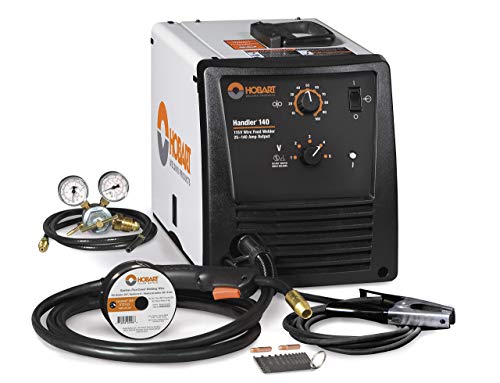
Type: MIG/Flux-core capable wire-feed welder. Power: 115V input. Capability: Listed to weld up to 1/4 inch mild steel. The unit is advertised as durable and portable for home, farm, and auto work.
Key features include a Quick Select drive roll and polarity changeover that simplify switching between wire types and sizes. The dual-gauge regulator provides gas monitoring for MIG with shielding gas. The Hobart Handler 140 is commonly recommended where consistent penetration on 1/4″ mild steel is required without heavy industrial power.
Millermatic® 142 MIG Welder – 120V, Portable

Type: MIG wire-feed with Auto-Set™. Power: 120V. Capability: Specified up to 3/16″ steel in auto mode, but features and control make it usable for lighter 1/4″ tasks with proper technique and settings.
The Auto-Set function automatically suggests parameters based on wire diameter and material thickness, reducing setup time. Its segmented display supports both manual and auto modes for users transitioning from hobby to light fabrication tasks. Consider this model if you value quick setup and portability, but verify your expected joint type for consistent 1/4″ penetration.
Fanmao 10 Pcs 2″ × 4″ Welding Coupons Practice Kit

Type: Practice coupons. Material: Low carbon steel. Dimension: 2″ x 4″ x 1/4″. These plates are for welding practice, qualification testing, and learning bead placement on the exact thickness you’ll be working with.
Coupons help validate settings and technique before committing to final parts. Low carbon steel coupons are appropriate when practicing on 1/4″ mild steel to evaluate heat input, joint fit-up, and travel speed. The 10-piece kit gives multiple weld tests including butt, fillet, and lap joints.
Therwen 2 Pcs 1/4″ x 8″ x 8″ Steel Plate

Type: Hot rolled A36 steel plate. Size: Two 8″ x 8″ x 1/4″ plates. Use: Material stock for cutting, tack welding, practice, or small fabrications that require certified thickness and workable surface.
A36 hot-rolled plate offers typical structural properties for fabrication. These plates are convenient when you need larger test pieces than coupons, or when building brackets and small components where 1/4″ thickness is the design requirement. Surface finish is suitable for welding prep and general fabrication.
Chicago Pneumatic CP7408 – Air Die Grinder Tool

Type: Air die grinder (right angle). Power: 0.34 HP, 23,000 RPM. Purpose: Weld prep, grinding, and finishing on 1/4″ steel joints. Useful for cleaning welds, achieving proper edge bevels, and polishing finished surfaces.
Proper preparation and cleanup affect weld quality on 1/4″ steel. A compact high-speed grinder allows precise grinding in tight areas and speeds removal of mill scale, paint, and slag. The lock-off throttle improves safety during shop use; pair with suitable air supply and PPE.
Buying Guide: Choosing A Welder And Accessories For 1/4 Inch Steel
This buying guide covers key considerations for welding 1/4″ (0.25″) steel across power, process, consumables, preparation, and accessories.
Welding Process: MIG vs. Stick vs. TIG
- MIG (GMAW): Easiest for beginners, fast deposition, good for butt and fillet welds on 1/4″. Gas-shielded MIG produces cleaner beads; flux-core can be used outdoors.
- Stick (SMAW): Portable and tolerant of dirty materials; requires more skill for neat beads but capable of 1/4″ penetration with proper electrodes.
- TIG (GTAW): Best for precision and aesthetics but slower; not necessary for most 1/4″ structural work unless finish is critical.
Power And Duty Cycle
- Input Voltage: 120V machines are convenient and portable; ensure the chosen unit can reliably penetrate 1/4″ steel for your joint type.
- Duty Cycle: Higher duty cycles enable longer continuous welds. For frequent fabrication on 1/4″ plate, prioritize higher duty cycle ratings to avoid waiting for cool-down.
Wire, Electrodes, And Shielding
- MIG Wire: For 1/4″, 0.030″–0.035″ ER70S-6 typically works well in solid wire MIG. Use gas shielding (C25 or 75/25) for best results.
- Flux-Core: Useful outdoors or where gas is impractical; choose wire and polarity compatible with your welder.
- Stick Electrodes: 7018/6011/6013 selections depend on position and cleanliness of material.
Joint Type And Fit-Up
- Butt Joints: For full penetration on 1/4″, consider a single-V or double-sided weld or proper beveling if using lower amperage machines.
- Fillet Joints: Easier to achieve on 1/4″ but watch travel speed to avoid undercut or insufficient throat.
- Gap Control: Proper gap and tack welding help avoid burn-through or lack of fusion.
Preparation Tools And Accessories
- Coupons And Plates: Use practice coupons and material stock of the same thickness to dial in settings before welding final pieces.
- Grinders And Cutters: Angle grinders, die grinders, and flap discs prepare edges and clean scale. A compact high-RPM die grinder is helpful for tight spots.
- Clamps And Fixtures: Ensure proper alignment and minimize distortion during welding.
Safety And PPE
- Helmet: Auto-darkening or fixed shade suitable for MIG amperage.
- Gloves, Jacket, And Ventilation: Protect against spatter and fumes when welding 1/4″ steel.
- Respiratory Protection: Use appropriate respirators when welding coated metals or in confined spaces.
Comparison Perspectives
- Beginner/DIY: Portable 120V MIG machines with Auto-Set features reduce setup complexity; pair with practice coupons to build skill.
- Hobbyist/Light Fabrication: Machines with slightly higher output and better duty cycle (e.g., models rated to weld 1/4″) provide versatility for structural parts.
- Professional/Shop Use: Look for robust frames, higher duty cycles, gas capability, and serviceability. Invest in quality grinders and consumables for consistent results on 1/4″ plate.