Choosing the right torque wrench for engine building matters for accurate fastener preload, repeatable clamping force, and avoiding damaged threads or warped components. Below is a quick comparison of selected torque wrenches suited for engine and precision assembly tasks.
| Product | Drive/Type | Torque Range |
|---|---|---|
| LEXIVON 3/8-Inch Drive Click Torque Wrench (LX-182) | 3/8″ Click | 10–80 ft·lb / 13.6–108.5 Nm |
| SUERCUP 3/8-Inch Drive Click Torque Wrench | 3/8″ Click | 5–45 ft·lb / 6.8–61 Nm |
| SUERCUP 3/8-inch Digital Torque Wrench | 3/8″ Digital | 1.5–99.6 ft·lb / 2–135 Nm |
| LEXIVON Bike Torque Wrench 1/4-Inch Dr. 15-Piece Kit | 1/4″ Click Kit | 2–26 Nm / 17.7–230.1 in·lb |
| FALOSI 1/4-inch Drive Beam Torque Wrench | 1/4″ Beam | 0–80 in·lb / 0–9 Nm |
LEXIVON 3/8-Inch Drive Click Torque Wrench 10~80 Ft-Lb
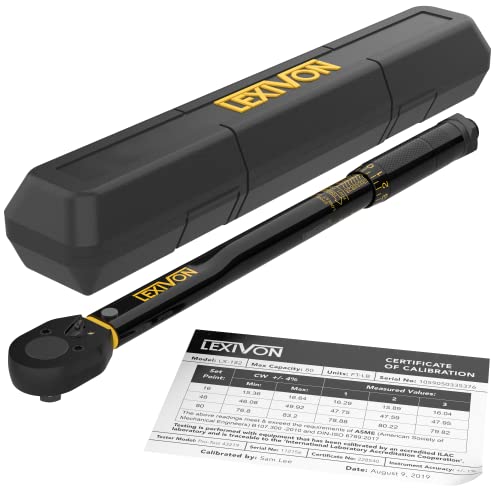
Drive And Range: 3/8-inch drive, 10–80 ft·lb (13.6–108.5 Nm). Accuracy: Ships pre-calibrated to ±4% with a calibration certificate and traceable serial number. Construction: Reinforced ratchet head from heat-treated Chrome Vanadium alloy steel and an Electro-Black finish for corrosion resistance. This model is aimed at general automotive engine tasks where mid-range torque control and a documented calibration are important.
SUERCUP 3/8-Inch Drive Click Torque Wrench 5-45 Ft-Lb

Drive And Range: 3/8-inch drive, 5–45 ft·lb (6.8–61 Nm). Accuracy: Claims ~±3% after production testing. Design: 72-tooth bidirectional ratchet head, chrome-vanadium and chrome-moly materials, and a distinct audible click to indicate target torque. This tool covers many common engine fasteners and includes bi-directional measurement for jobs that require reverse torque checks.
SUERCUP 3/8-inch Digital Torque Wrench 1.5-99.6 Ft.Lb

Drive And Range: 3/8-inch digital, 1.5–99.6 ft·lb (2–135 Nm). Accuracy & Features: Up to ±1% accuracy, vibration/buzzer/LED overload warnings, multiple units, 9 preset modes, data storage up to 500 sets. Use Case: Digital readout and audible/vibration alerts support precise engine assembly where numeric confirmation and repeatable settings are required.
LEXIVON Bike Torque Wrench 1/4-Inch Dr. 15-Piece Kit

Drive And Range: 1/4-inch drive, 2–26 Nm (17.7–230.1 in·lb) with micro-adjustments to 0.2 Nm. Precision: Pre-calibrated, CW ±4% and CCW ±6%, includes calibration certificate. Kit Contents: 15 pieces including multiple hex and Torx bits, 3-inch extension and 1/4″ adapter. Relevance: Useful for engine-related components with small fasteners—valve cover bolts, sensors, and accessories—especially when multiple bit types and micro-adjustment matter.
FALOSI 1/4-inch Drive Beam Torque Wrench 0-80 In/Pounds

Drive And Range: 1/4-inch beam type, 0–80 in·lb (0–9 Nm). Accuracy & Durability: Dual measurement, mirror-chrome finish, claimed ±4% accuracy. Advantages: Beam (deflection) wrenches do not rely on springs or internal mechanisms that can drift with use, so they offer stable long-term accuracy for low-torque engine tasks such as throttle body screws, sensors, and small accessory bolts.
Buying Guide: Choosing A Torque Wrench For Engine Building
Drive Size: Engine work commonly uses 3/8″ and 1/2″ drives for head bolts, main caps, and larger fasteners. Use 1/4″ drive tools for small sensors, brackets, and accessories. Select the drive appropriate for the torque range and socket size you need.
Torque Range And Resolution: Match the wrench range to your typical tasks. For cylinder head bolts and rod bolts you often need higher ranges (use a 3/8″ or 1/2″ with adequate range). For accessory and sensor fasteners, 1/4″ or low-range beams/clickers are ideal. Avoid using a wrench at the very bottom or top of its range for best accuracy.
Accuracy And Calibration: Engine assembly benefits from tools with known calibration. Look for pre-calibrated tools with a calibration certificate or a specified accuracy (±1–4%). Consider whether you need periodic recalibration and whether the manufacturer offers traceable calibration options.
Click vs Digital vs Beam: Click (mechanical) wrenches provide an audible/tactile indication when target torque is reached and are common for torque-critical engine fasteners. Digital wrenches give numeric readouts, multiple units, audible/vibration alerts, and data logging for documented builds. Beam wrenches are simple and stable for low-torque precision where long-term drift is a concern.
Build Quality And Ratchet Teeth: For engine work, ratchet heads with higher tooth counts (e.g., 72-tooth) allow smaller arc swing in tight spaces. Hardened, heat-treated alloy heads and corrosion-resistant finishes extend life under shop conditions.
Bidirectional Measurement: Some assembly steps require measuring torque in either direction. Choose a wrench that supports CW and CCW where necessary, and check stated accuracy for both directions.
Accessories And Kit Contents: Kits including extension bars, adapters, or a set of bits reduce the need for separate purchases—useful when the job requires multiple fastener types. For engine builds, extension bars and adapters help reach recessed fasteners.
Data Logging & Presets: For professional or documented engine builds, digital wrenches with preset modes, data storage, and connectivity support traceability and quality control.
Use And Maintenance: Store torque wrenches at their lowest setting when not in use, avoid using them as breaker bars, and follow the manufacturer’s recalibration interval recommendations to maintain accuracy.
Comparison Perspectives:
- Precision-Focused: Choose digital or high-accuracy click wrenches with calibration certificates (digital SUERCUP or LEXIVON pre-calibrated models).
- Low-Torque Precision: Beam or 1/4″ click wrenches (FALOSI beam, LEXIVON 1/4 kit) for sensors, throttle bodies, and small fasteners.
- Mid/High Torque Engine Bolts: 3/8″ click or higher-range digital wrenches (LEXIVON LX-182, SUERCUP 3/8 digital) for head and main fasteners when within instrument range.
- Shop Documentation: Digital wrenches with data logging are best when you must record applied torque values for quality control.