Choosing the right thin kerf blade can dramatically improve accuracy, reduce waste, and speed up cutting. This guide highlights top options designed for clean finish cuts on plywood, melamine, solid wood, and dense hardwoods. We compare kerf width, tooth geometry, carbide quality, and overall build to help you select blades that align with common table saw tasks—from ripping and crosscutting to fine finish work.
| Product | Brand | Kerf/Teeth | Main Use | Key Benefit |
|---|---|---|---|---|
| Freud LU83R010 Industrial 10-in 50T | Freud | 0.094″ kerf, 50T | General purpose / crosscut | TiCo carbide blend, non-stick coating |
| Freud LU87R010 10″ Thin Kerf Rip | Freud | 0.094″ kerf, 24T | Rip cuts | Hi-density carbide for ripping, reduced waste |
| CMT 256.050.10 ITK Xtreme ITK 10″ | CMT ORANGE TOOLS | 0.098″ kerf, 50T | Rip and crosscut | Large gullets for chip clearance, versatile |
| Freud LU88R010 10″ Thin Kerf Fine Finish | Freud | 0.090″ kerf, 60T | Fine finish crosscuts | Hi-Density carbide, smooth edges |
| Freud LM75R010 Glue Line Ripping | Freud | 0.091″ kerf, 30T | Glue line ripping | Heavy-duty, stable for long cuts |
The selections focus on blades engineered for thin kerf performance, balancing fast material removal with clean edges. Each blade here is designed for common American workshop tasks, from cabinetry and plywood finishing to general ripping on a table saw. The list blends well-known brands with specialized designs to cover a broad range of materials and cutting needs.
Freud LU83R010 Industrial 10-in 50T Thin Kerf Combination

The Freud LU83R010 combines a 10-inch diameter with a 50-tooth configuration, offering a balanced approach for general-purpose crosscuts and rips. Its TiCo high-density carbide delivers wear resistance and long life, while Non-Stick Perma Shield coating helps minimize buildup on harder materials. The blade features an anti-vibration design to support steadier cuts and reduce chatter in typical shop environments.
Freud LU87R010: 10″ Thin Kerf Rip Blade

This ripping blade uses a 5/8-inch arbor and a 10-inch diameter with a .094″ kerf. The 24-tooth design prioritizes fast material removal while maintaining edge quality. Its TiCo high-density carbide is optimized for ripping performance, and the thin kerf reduces resistance, enabling quicker feed rates and less waste in softwoods and hardwoods alike.
CMT ITK Xtreme 10-Inch Combination Blade

The CMT ITK Xtreme blade is designed for both ripping and crosscutting, with a 0.098″ kerf and 0.071″ plate thickness. It features a 15-degree hook angle and a flat grind plus 4/20-degree alternating teeth, enabling efficient chip clearance while delivering solid performance across a range of wood products, including plywood and laminates.
Freud LU88R010: 10″ Thin Kerf Fine Finish Crosscut

With 60 teeth and a Hi-Density TiCo carbide blend, the LU88R010 is optimized for fine finish crosscuts. The 0.090″ kerf and 5/8″ arbor facilitate smooth, precise cuts in veneers, hardwoods, and solid wood molding. Positive hook angles support efficient feeding while preserving edge quality on delicate materials.
Freud LM75R010: Glue Line Ripping Blade
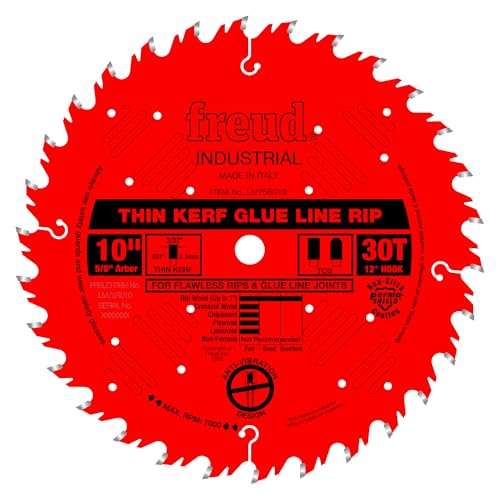
The LM75R010 is a dedicated glue line ripping blade designed for stable, flat cuts on thick stock and plywood. Its 30 teeth and 0.091″ kerf balance aggressive material removal with consistent edge quality. The 5/8″ arbor and heavy-duty construction support long, straight rip cuts across tough materials used in cabinetry and framing projects.
Freud Thin Kerf Ultimate Plywood & Melamine Blade

This blade uses a Hi-ATB tooth geometry with an 80-tooth count to deliver ultrafine finishes on veneered plywood, melamine, and laminates. The premium TiCo carbide blend provides edge retention and consistent performance, while the Hi-ATB design minimizes tear-out on delicate surfaces and moldings. It is ideal for cabinetmaking and finish carpentry tasks requiring sharp, clean edges.
Buying Guide
Key purchase considerations for thin kerf blades:
- Kerf width: Narrow kerfs reduce material waste and require less power, but must match your blade height and saw throat plate for best results.
- Tooth geometry: Hi-ATB designs excel at reducing tear-out on veneers and laminates, while ATB and flat-grind combinations balance speed and finish quality.
- Material compatibility: Choose blades with carbide blends rated for wood, plywood, laminates, melamine, and dense hardwoods if your work spans multiple substrates.
- Arbor size and plate thickness: Most 10″ blades use a 5/8″ arbor; ensure your saw supports thinner plates to prevent vibration and warping.
- Coatings and anti-vibration features: Perma Shield coatings reduce buildup; anti-vibration designs improve cut precision and user comfort.
- Application focus: For cabinetry and finish carpentry, prioritize fine-crosscut blades with higher tooth counts. For rough ripping, select aggressiveness and durability over finish quality.
When evaluating blades, consider the balance between speed, cut quality, and life expectancy. In practice, you may want a dedicated ripping blade for heavy stock and a separate finish blade for veneers and cabinet parts. Thin kerf blades are especially beneficial in portable or lighter saws where power is a consideration, helping to maintain cutting speed without overloading the motor.