When outage risk rises—from storms to peak demand—having a dependable standby generator that runs on propane can provide peace of mind and steady power. Below are five top options that balance automatic operation, fuel flexibility, and smart features. Each product is evaluated for standby readiness, transfer-switch integration, and long-term reliability to help you pick the best propane-powered backup solution for a American home.
| Product | Brand | Key Benefit |
|---|---|---|
| Generac Guardian 22kW | Generac | High-end whole-house backup with 200 Amp transfer switch; WiFi monitoring |
| Generac Guardian 10kW | Generac | Balanced power for mid-size homes with solid transfer switch and WiFi |
| WEN 14,500-Watt Tri-Fuel | WEN | Fuel flexibility (gas, propane, natural gas) with CO watchdog |
| DuroMax XP13000EH | DuroMax | Dual-fuel portability with whole-home potential and RV capability |
| Westinghouse 12,500 EFI Dual Fuel | Westinghouse | Dual-fuel with EFI engine and transfer-switch-friendly outlets |
Generac Guardian 22kW Standby Generator

The Generac Guardian 22kW is designed for whole-house backup with a robust 200 Amp transfer switch. It supports natural gas or propane operation and includes Mobile Link Wi-Fi connectivity for remote monitoring and maintenance alerts. The outdoor-ready aluminum enclosure helps withstand weather while keeping the system accessible for service. A 5-year limited warranty provides long-term assurance, and the integrated transfer switch ensures automatic restoration of power during outages without manual intervention.
Generac Guardian 10kW Standby Generator

This 10kW Generac model pairs a 100 Amp transfer switch with a durable aluminum enclosure for outdoor use. The Mobile Link Wi-Fi capability lets you monitor generator status and maintenance remotely, which is helpful if you’re away during a storm. It’s backed by a 5-year limited warranty, focusing on reliability for mid-sized homes and spaces that require consistent whole-house backup power.
WEN 14,500-Watt Tri-Fuel Generator

The WEN TF1450X provides fuel flexibility with a simple dial to switch among gasoline, propane, and natural gas. It operates at both 120V and 240V, making it a strong match for transfer switches and whole-home backup scenarios. A CO watchdog adds safety by automatically shutting down during dangerous carbon monoxide levels. This option suits homeowners who want fuel choice without sacrificing portability or performance during emergencies.
DuroMax XP13000EH Dual-Fuel Ready

The DuroMax XP13000EH delivers 13,000 watts and dual-fuel capability to adapt to fuel availability during emergencies. It’s designed for whole-home backup with an emphasis on reliability and rugged construction, supporting both portable use and transfer-switch readiness, making it a flexible option for homeowners who want room to scale power delivery across a larger property or RV priorities.
Westinghouse 12,500 EFI Dual Fuel
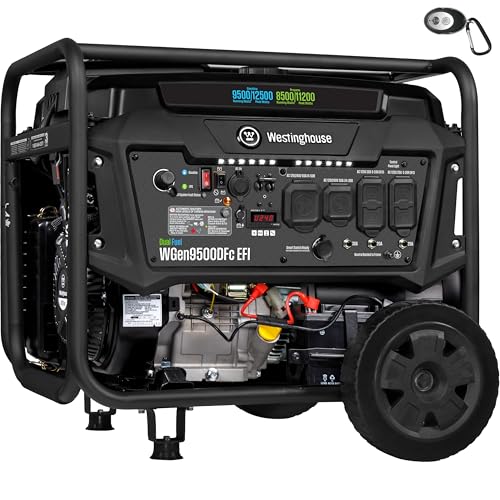
This Westinghouse model uses an EFI-based engine, offering efficient fuel usage and smoother operation. It delivers dual-fuel flexibility and transfer-switch-friendly outlets, including a range of 120V and 240V receptacles to accommodate home installations. A built-in CO sensor adds safety, while the CO watchdog and digital hour meter help with routine maintenance and safer operation during outages.
Buying Guide: Key Considerations For Standby Propane Generators
Choosing the right standby propane generator involves balancing power needs, fuel availability, and installation requirements. Consider these perspectives:
- Power requirements: Assess your home’s essential circuits and total load. Larger homes may need 20kW or more, while smaller homes can operate comfortably on 10kW–12kW models. Transfer switch size should match this load.
- Fuel flexibility: Propane-only units simplify fuel storage but may limit run time if propane is scarce. Dual-fuel or tri-fuel models offer more options during emergencies.
- Transfer switch integration: A compatible automatic transfer switch (ATS) ensures seamless power restoration. Look for outdoor-rated enclosures and proper electrical codes compliance.
- Remote monitoring: WiFi-enabled monitoring helps you track status and maintenance while you’re away. Ensure the app is user-friendly and reliable.
- Noise and emissions: Quieter operation and low emissions contribute to neighborhood compatibility and safety. Look for units with quiet-test modes and CO sensors.
- Installation considerations: Outdoor placement, venting, and electrical clearance affect longevity and serviceability. Professional installation is typically required for safety and code compliance.
- Warranty and service: A robust warranty (5 years or more) and access to authorized service are important for long-term reliability.
- Portability vs. permanence: Standby systems are fixed installations; portable dual-fuel models offer flexibility but may require more setup for continuous backup.
For homeowners prioritizing full-house resilience, a larger model with a high transfer-switch rating paired with WiFi monitoring can provide consistent power during outages. If you anticipate fuel supply variability, a tri- or dual-fuel generator enhances options. Safety features like CO monitoring and automatic shutoff add important protections during operation.