Finding a reliable stair tread jig is essential for achieving precise, repeatable measurements on any staircase project. The right jig helps lock in width, length, and angle, reducing waste and speeding up installation. Below, five top options—each backed by robust aluminum construction and smart locking mechanisms—offer dependable performance for DIY enthusiasts and professional carpenters alike. Explore their key features, and read a practical buying guide to choose the best fit for your projects.
| Product | Brand | Key Benefit |
|---|---|---|
| PUIOCO Stair Tread Template Tool (Red) | PUIOCO | Triangular locking, edge flip stops, 12″ pivot for many treads |
| SUNLFPROD Stair Tread Template Tool | SUNLFPROD | Flexible extensions from 10.5″ to 60.5″, durable aluminum |
| Gohelper Portable Stair Tread Template Tool | Gohelper | Double nut-locking for error-free transfers, simple assembly |
| Victoam Stair Tread Template Tool | Victoam | Two extension sets, adjustable length and angle for diverse stairs |
| Eleon Stair Tread Template Tool | Eleon | 11″ x 3.2″ gauge with adjustable width, durable aluminum |
PUIOCO Stair Tread Template Tool (Red)

The PUIOCO red model features a reliable triangular structure locking mechanism that prevents pivot ends from moving. The design includes washers between the auxiliary bar and pivot ends to minimize displacement during use, enabling precise measurements. An edge flip stop at both ends ensures alignment with the tread edge, allowing quick replication of templates across projects. The 12″ pivot end spans the width of most stair treads, accommodating common stair configurations. The auxiliary bar is detachable for convenient storage and setup, and the overall construction emphasizes strength and accuracy for carpenters and DIYers alike.
SUNLFPROD Stair Tread Template Tool

Sunlfprod’s model emphasizes a flexible extension system that ranges from 10.5″ to 60.5″ thanks to 16″, 12″, and 8″ extensions. The tool is designed for wide applicability, supporting stair treads, risers, flooring, shelves, and windowsills. Constructed from aerospace-grade aluminum alloy, it provides rust resistance and durability over time. Laser-etched markings add long-lasting accuracy. This jig is well-suited for both DIY projects and professional carpentry tasks, offering a broad working envelope without compromising precision.
Gohelper Portable Stair Tread Template Tool

Gohelper’s tool emphasizes error-free transfers with a dual nut-locking structure that firmly fixes the two pivot ends, reducing measurement drift due to bumps. The adjustable range spans 23″ to 48.2″ in its basic configuration, with the option to extend to 64.2″ using a 16″ extension. Its simple assembly and compact components help users stay organized on job sites. The 14″ pivoting ends and dual pin stops support reliable edge alignment, enabling quick and accurate transfer of tread angles and depths to the workpiece, thus boosting workflow efficiency.
Eleon Stair Tread Template Tool

Eleon’s aluminum alloy gauge is designed for effortless stair measuring with an 11″ x 3.2″ footprint. The adjustable design supports tread widths and lengths from 8″ to 56″, delivering reliable performance for varied stair configurations. A CNC-anodized surface reinforces durability for tough projects, and its straightforward adjustment supports a quick setup, making it a practical choice for both newcomers and seasoned woodworkers seeking consistent results.
Victoam Stair Tread Template Tool
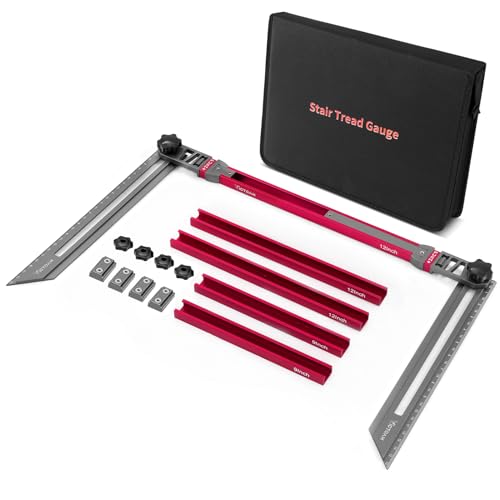
Victoam offers a versatile solution with two extension sets (16 inches and 9 inches), enabling adjustable lengths from 17.9″ to 58.9″. The tool supports adjustable angles to accommodate different stair corners, making it suitable for carpenters dealing with irregular staircases. The design emphasizes stability and precise angle transfer, helping minimize waste and improve accuracy in measurement and layout tasks for stair projects of varying complexity.
Buying Guide: Key Considerations For A Stair Tread Jig
When selecting a stair tread jig, consider how you will use it most often, the range of stairs in your projects, and how critical precision is to your outcomes. Here are essential factors to compare across models:
- Locking stability: Look for a triangular or robust locking mechanism that prevents pivot ends from shifting during measurement and transfer. Edge stops at both ends help maintain alignment with the tread edge.
- Adjustability: A wider range of lengths and adjustable angles expand applicability to different stairs. Tools with multiple extension pieces, or integrated adjustable ends, offer flexibility across projects.
- Material and finish: Aluminum alloy tools provide a balance of lightweight handling and durability. A CNC anodized surface can resist wear and corrosion in shop environments.
- Ease of use: Minimal assembly and intuitive adjustments save time on busy job sites. Tools with magnetized stops or quick-lock features reduce setup friction.
- Accuracy features: Laser-etched markings, precise pivot end geometry, and locking washers help maintain consistent templates and reduce material waste.
- Portability and storage: Detachable components or compact designs are advantageous for transport between sites or storage in limited spaces.
- Compatibility with stair types: Some tools excel for straight runs, while others handle irregular angles or curved stairs. Assess the typical stair designs you encounter.
How To Use A Stair Tread Jig Effectively
Begin by aligning the jig with the tread edge using the edge stops. Extend or collapse the tool to match the target tread width and length. Lock all pivot points securely, then transfer the measured template to your board or material. For varying stair angles, adjust the pivot end orientation to match the stair geometry. Recheck alignment after any adjustment to ensure the template remains true as you mark or cut the workpieces. Regularly inspect components for wear to preserve measurement accuracy over time.
Common Applications And Prospective Uses
Stair tread jigs are not limited to traditional stairs. They are valuable in laying out treads for stairs that connect different levels, creating accurate risers for built-in shelves or partitions, and facilitating template-driven cutting for stair landings. Tradespeople also use these tools to reproduce templates across multiple projects, such as multi-floor renovations, ensuring consistent stair geometry throughout a building. The right jig reduces material waste by delivering repeatable, precise results and speeds up the project timeline.
Additional Considerations: Durability, Maintenance, And Compatibility
Durability is tied to the quality of the aluminum alloy and the finish. Regular cleanup after use helps prevent corrosion and ensures edge stops remain effective. Check for compatibility with extension pieces and whether attachments are compatible with your existing tools. Consider whether a tool offers detachable bars or modular components for easy transport and storage. Finally, evaluate whether the tool’s length range covers your most common stair widths to avoid frequent readjustments on the job.
Conclusion
Choosing the right stair tread jig involves balancing range, stability, and ease of use. The five options highlighted above provide a spectrum of adjustability and locking features to fit a variety of stair designs and project scales. By focusing on robust locking mechanisms, extendable lengths, and durable construction, you can select a jig that delivers consistent, accurate templates with minimal waste and maximum efficiency.