Quick Overview: This guide reviews five battery spot welders suitable for building and repairing battery packs like 18650/21700 cells. Below is a summary table of the selected models to help you compare core specs at a glance.
| Model | Type | Notable Features | Best For |
|---|---|---|---|
| AWithZ 1.5″ LCD 11000mAh | Portable Battery-Powered | 11000mAh internal battery, 99 gears, continuous welds | Field repairs, cordless use |
| Docreate 8000W Handheld | High-Power Handheld (Capacitor-style output) | Dual pulse, foot pedal, 0-800A knob | Heavy-duty nickel strip welding |
| AWithZ 14.6KW P20B | Capacitor Spot Welder | 2-in-1 auto & foot pedal, 999 gears, wide material range | Battery pack assembly and diverse metals |
| SeeSii Handheld With Tester | Portable Integrated | Built-in battery tester, color LCD, compact design | Home hobbyists who need diagnostics |
| Awgem 99 Gear Handheld | Portable Handheld | Integrated pen, LCD, auto/manual modes | One-handed welding and small pack work |
AWithZ 1.5″ LCD 11000mAh Portable Spot Welder
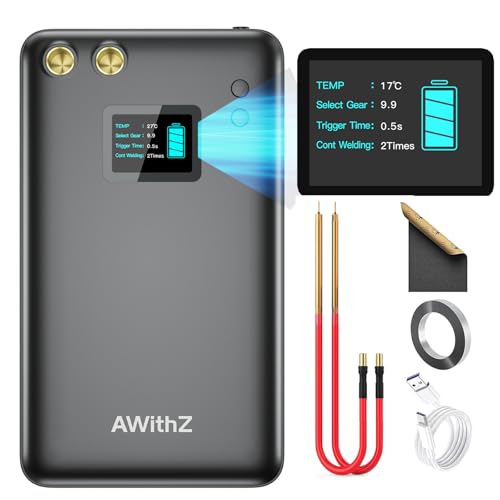
This AWithZ model is a battery-powered portable spot welder with an internal 11000mAh battery and an LCD readout. It lists 99 adjustable gears to match different material thicknesses, and supports continuous dual-spot welding to handle slightly thicker joints. The product description highlights use for rebuilding battery packs (18650 etc.), small appliance battery replacement, and making hooks on metal.
Strengths noted in the features include cordless operation for field or workshop mobile use, a relatively fast charge time, and a wide gear range for thin to moderate thickness materials. This model is positioned for users who need portability and variable power control.
Docreate 8000W Handheld Spot Welder

The Docreate 8000W unit is described as a high-power handheld spot welder with dual pulse output and a foot pedal mode. It claims effective welding for 0.1–0.3mm nickel strips and adjustable output via a 1–9 level knob, translating to a claimed 0–800A range. The unit includes a soldering pen and a removable tip design for maintenance or replacement.
Key functional points: foot-pedal control for hands-free triggering, level knob for output tuning, and capability aimed at efficient, repeated welds on nickel strips used in battery packs. The manufacturer emphasizes ergonomic control and continuous welding capability after a full charge.
AWithZ 14.6KW Capacitor Spot Welder P20B

The AWithZ P20B is a capacitor-based spot welder offering 14.6KW peak capability and two operation modes: automatic and foot pedal. It supports a large gear range (up to 999 gears) and wide input voltage for quick start. The description lists suitability for many materials including nickel, stainless steel, iron, copper, and various battery chemistries.
Operational notes from the features: fast readiness via high-current adapter, selectable modes for automation or manual timing, and wide material thickness compatibility. This model targets users building larger or mixed-material battery packs who need higher energy and flexible control modes.
SeeSii Handheld Spot Welder With Battery Tester

SeeSii offers a compact handheld spot welder with an integrated battery tester. The combination provides welding capability for 0.1–0.25mm nickel strips plus on-device diagnostics to read cell voltage and remaining battery life. The color LCD shows gear settings and operational status for quick checks during pack building.
According to the features, this unit is aimed at hobbyists and technicians who want welding and basic testing in one tool. The integrated pen and compact form factor favor convenient one-handed use and rapid voltage checks during assembly or repair workflows.
Awgem 99 Gear Handheld Spot Welder With LCD

Awgem’s handheld spot welder combines an integrated welding pen with an LCD and 99 adjustable gears. The unit supports both automatic and manual modes and highlights one-handed operation so the user can hold nickel strips or cells with the other hand. The display provides settings like preheating and delay time.
Features emphasize ergonomic handling, digital control options, and dual-mode flexibility for different pack sizes and strip thicknesses. The integrated design reduces the need for separate cables or external pen modules.
Buying Guide: Key Considerations When Choosing A Battery Spot Welder
Choosing the right spot welder depends on application scale, materials, and workflow preferences. Below are the main factors to weigh.
Type: Portable Battery vs. Capacitor/High-Power Units
- Battery-powered portable welders (internal battery packs) offer cordless convenience and portability for field repairs and small pack builds. They often have limited peak output compared with capacitor units.
- Capacitor-based or high-power handheld welders deliver higher instantaneous energy for thicker nickel strips and repeated heavy-duty welds. They are better for production or larger pack assembly but are bulkier and may need mains power.
Adjustable Output And Gears
- Multi-gear or knob adjustments let you fine-tune energy to avoid damaging cell tabs or failing to fuse strips. More gears offer finer control for different strip thicknesses and materials.
- Look for dual pulse or multi-pulse modes when working with sensitive cells or stubborn materials for smoother welds.
Operation Modes And Controls
- Automatic Mode can simplify repetitive welding by delivering consistent pulses at preset energy.
- Manual Mode or pedal-triggered modes provide control for precise placement and positional adjustments.
- Foot pedals free both hands for alignment and are useful for higher-volume tasks.
Materials And Thickness Range
- Confirm the welder’s rated nickel strip thickness (typical ranges: 0.1–0.3mm). For copper or thicker stainless sheets, higher energy units or specialized tips may be required.
- Different battery chemistries and tab materials require different power settings — ensure the welder’s adjustment range covers your expected materials.
Portability, Power Source, And Charging
- Battery-powered models suit mobile work but check internal battery capacity and charge time for expected session length.
- AC-powered capacitors offer quick recovery between welds and higher peak energy; ensure compatibility with local mains voltage and adapter specs.
Ergonomics And Integrated Tools
- Integrated pens and one-handed designs simplify handling small packs. Removable tips and replaceable probes extend service life.
- Clear displays (LCD or color) that show gear, voltage, or remaining battery life help maintain consistent results.
Safety And Best Practices
- Always follow manufacturer safety guidance, including PPE (eye protection, gloves) and secure clamping of cells to avoid movement during welds.
- Avoid excessive energy settings that can damage cells; perform test welds on scrap strip to dial in settings.
- Allow proper cooling time between repeated welds as specified by the tool to maintain capacitor recharge or battery health.
Comparison Perspectives
- For occasional hobby use and portability: battery-powered portable welders with integrated pens and moderate gear ranges are typically sufficient.
- For assembly lines or larger battery packs: capacitor or high-power units with foot pedals and broad gear ranges offer greater throughput and consistency.
- For diagnostics-focused workflows: models that combine a tester and welder reduce tool switching and speed troubleshooting.