Keep spaces like chicken coops, greenhouses, sheds, and patios cooler using solar powered fans. This guide highlights five reliable models, each with strong airflow, battery backup, and weather-ready design. Compare features, run times, and solar charging capabilities to choose the right option for day-and-night ventilation without relying on grid power.
| Product | Brand | Key Benefit |
|---|---|---|
| Pqins 7.1″ Solar Fan with Battery | Pqins | Dual 7.1″ high-velocity fans with 25600 mAh battery for dusk-to-dawn operation |
| Maraiss 22000mAh Camping Solar Fan | Maraiss | Two solar panels for faster charging and 5-speed quiet operation |
| Pqins 7.1″ Large Solar Greenhouse Fan | Pqins | Separate solar panel and fan design with strong 3800 RPM airflow |
| Gliztech Solar Ceiling Fan Light | Gliztech | Ceiling-style portable fan with built-in 20000 mAh battery and light |
| GROWNEER Solar Powered Exhaust Fan | GROWNEER | Smart battery backup and 1200 CFM for large spaces up to 1400 sq ft |
Pqins 7.1″ Solar Fan With Battery
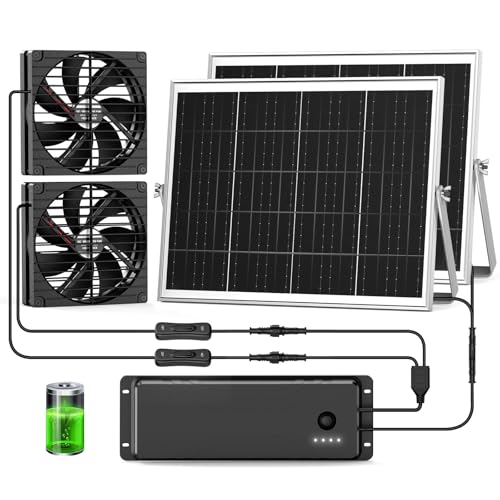
The Pqins 7.1″ solar fan combines daytime operation with battery storage to power a fan into the night. It features two high-velocity 7.1″ DC fans delivering up to 3800 RPM and up to 960 CFM airflow, suitable for chicken coops, greenhouses, or sheds. The 25600 mAh intelligent battery enables up to 10 hours of continuous operation after full charge. The system uses two 20W solar panels that both drive the fan and recharge the battery simultaneously, providing flexible placement for outdoor spaces. Its waterproof design helps withstand outdoor conditions.
The dual-fan configuration improves air turnover, reducing hot spots and stale air. With dusk-to-dawn capability, operators can maintain ventilation even after sunset. The unit is designed to be installed in small outdoor structures where compact size and strong airflow are priorities. It’s best suited for spaces around 80–120 sq ft and can be used for additional exhaust or intake depending on placement.
Key considerations: ensure ample sun exposure for optimal charging, verify mounting options for your coop or shed, and plan for cable routing that minimizes obstruction. The battery-backed operation helps mitigate brief cloud cover, but peak performance occurs during sunny periods.
Maraiss 22000mAh Camping Solar Fan

The Maraiss solar fan emphasizes quiet operation with its brushless motor and 5-speed control. It uses two high-efficiency monocrystalline solar panels to deliver rapid charging, paired with a 22,000 mAh battery for 4–20 hours of runtime depending on speed. Recharge options include solar, USB-C, or wall adapter, providing flexibility when sunlight is limited. An integrated LED lighting feature offers triple lighting modes and a 5-stage timer, allowing the unit to double as a camping light source when needed. It’s ideal for tents, cabins, or remote workspaces where power access is limited.
Performance balance: the two-panel design improves solar intake and reduces charging time, while the LED functionality adds value for nighttime use. The unit’s runtime varies by wind speed and panel efficiency, so users should anticipate shorter runs at higher speeds. Noise remains low, making it suitable for sleep, study, or focused tasks in outdoor environments.
Purchase considerations include panel placement for maximum sun, the reliability of USB-C charging cables, and the availability of a stable wall adapter if solar charging is inconsistent. The product excels where multi-use lighting and portable airflow are priorities.
Pqins 7.1″ Large Solar Greenhouse Fan

This Pqins model delivers strong airflow for greenhouse and coop environments with a 3800 RPM top speed and high airflow capacity. The fan is paired with a larger solar panel setup, allowing the unit to operate as both an exhaust and an intake system. The design separates the solar panel from the fan, enabling outdoor panel placement while the fan sits indoors or in a sheltered location. The build emphasizes durability, including IP67 waterproofing and robust metal construction, with a service life projected beyond seven years in challenging outdoor conditions.
Key strengths include high RPM for rapid air exchange, a flexible layout that accommodates multiple installation scenarios, and weather-resistant materials. Potential drawbacks are the need for outdoor panel placement and the possibility of longer cable runs, which require careful management to avoid obstruction. This option suits small to medium spaces where robust ventilation is essential.
Considerations: verify sun exposure, plan for secure mounting in outdoor spaces, and account for occasional wind loading if installed in exposed spots. This model is a strong pick for those prioritizing airflow and long-term durability.
Gliztech Solar Ceiling Fan Light

The Gliztech unit combines a 30W solar canopy fan with a built-in 20,000 mAh battery and a lighting feature, offering up to 8–35 hours of runtime depending on whether only the fan, only the light, or both are used. It supports dimmable, color-temperature lighting (3000K to 6500K) and remote control for convenience. The dual charging pathway includes a direct solar charge plus a secondary 13.5V/1.5A power supply option, enabling flexible operation even when sunlight is limited. This makes it suitable for patios, gazebos, and sheds where a soft lighting ambiance is a plus.
Strengths include integrated lighting, long runtime, and remote control. The design is quiet and efficient, but the combination of large battery and lighting means higher initial cost. For users needing both airflow and illumination in an outdoor pavilion or porch, this model provides a compact, all-in-one solution.
Shopping notes: ensure an unobstructed sun path for the solar panel, consider remote control reliability in sheltered areas, and check compatibility with existing outdoor outlets if you plan to run the unit on AC power as a backup.
GROWNEER Solar Powered Exhaust Fan
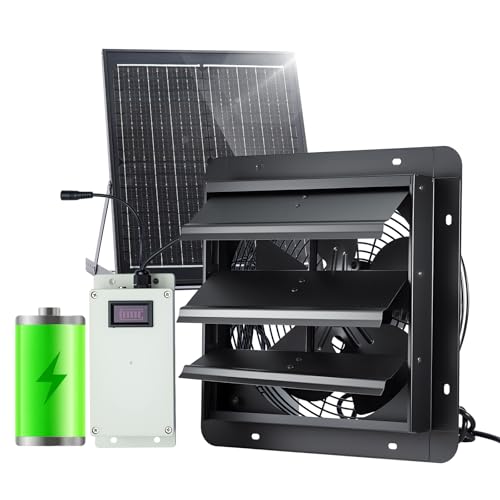
The GROWNEER exhaust fan features a smart power supply that prioritizes solar energy, with a built-in 3200 mAh battery that automatically switches during low light to ensure continuous operation. It delivers up to 1200 CFM at 1200 RPM and is capable of ventilating spaces up to 1400 square feet. The louvered body is constructed from metal for durability and features corrosion resistance to endure outdoor use. Noise remains manageable within the 40–60 dBA range, enabling ventilation without excessive disturbance. The automatic louvers help prevent dust ingress when the fan stops.
Strengths include strong airflow for medium-to-large spaces and reliable battery-backed operation. The unit is well-suited for greenhouses, attics, and large sheds. A potential limitation is the need for mounting space to accommodate the louvers and fan assembly. For spaces where effective airflow and weather resilience are priorities, this model offers robust performance and durability.
Buying Guide: What To Consider When Choosing A Solar Powered Fan
- Space size and airflow needs: Measure the area and target CFM or RPM to ensure the fan can circulate air effectively. Larger spaces typically require higher RPM and/or multiple fans.
- Power source and battery backup: Look for models with built-in batteries and dual charging options (solar plus USB or AC). Battery capacity affects runtime, especially on cloudy days.
- Panel placement and wiring: Ensure solar panels can face direct sunlight without shade. Consider cable length and routing to avoid tripping hazards or weather exposure.
- Durability and weather resistance: IP ratings, corrosion resistance, and sturdy mounting options determine long-term performance in outdoor environments.
- Noise and comfort: Brushless motors generally offer quieter operation. If you plan to run fans during sleeping hours, prioritize models with lower decibels.
- Multi-function features: Some units include lighting, timers, motion sensors, or remote controls. Consider which extras add practical value for your setting.
- Installation flexibility: Separate panels from fans provide versatile placement for optimal sun exposure and airflow.
Overall, solar powered fans provide a renewable solution for ventilation and cooling in remote or off-grid spaces. Evaluating solar input, battery capacity, airflow needs, and durability will help identify the best match for chicken coops, greenhouses, sheds, and outdoor living areas.