The right saw blade can make the difference between a flawless melamine edge and a frustrated project. The following selections focus on high-density carbide blades with Hi-ATB or improved tooth geometry designed to reduce tear-out, minimize chipping, and deliver smooth, accurate finishes on melamine, laminates, and veneered plywood. Each option is crafted to support finish carpentry, cabinet making, and durable crosscuts in hard woods and composites alike. Read on to compare performance, blade design, and best-use scenarios.
Overview table of chosen products:
| Product | Brand | Diameter | Teeth | |
|---|---|---|---|---|
| Freud Thin Kerf Ultimate Plywood & Melamine | Freud | 10″ | 80 | Hi-ATB with TiCo carbide |
| Freud LU80R010 | Freud | 10″ | 80 | Hi-ATB, Hi-Density Carbide |
| Diablo Fine Finish D0860X | Diablo | 8-1/4″ | 60 | Perma-Shield coating |
| Freud LU79R007 | Freud | 7-1/4″ | 60 | Hi-ATB, thin kerf |
| Norske NCSBP273 | Norske | 10″ | 80 | 35° ATB, anti-vibration |
Freud Thin Kerf Ultimate Plywood & Melamine Blade (10″, 80T)

This Freud blade is engineered for flush, clean cuts through veneered plywood, melamine, laminates, and crosscuts in solid wood. Its TiCo carbide blend delivers high-density performance, edge retention, and durability for demanding finish work and cabinetmaking. The Hi-ATB geometry enhances shearing action, reducing tear-out and producing polished edges on delicate materials.
Freud LU80R010: 10″ Ultimate Plywood & Melamine Blade

This 10-inch blade features an arbor of 5/8″, a Hi-ATB grind, and a 2-degree hook angle with 0.126″ kerf. Its 80 teeth are designed for smooth crosscuts and veneered surfaces, while the TiCo Hi-Density carbide blend provides robust performance and edge retention. The Hi-ATB geometry minimizes splintering and delivers clean, precise cuts in melamine and plywood alike.
Diablo Fine Finish Blade with Tico Hi-Density Carbide (8-1/4″)
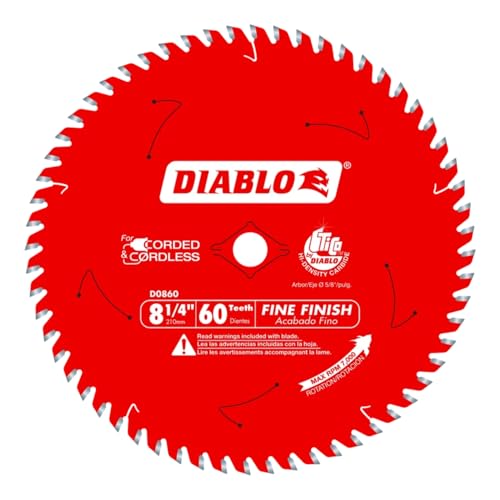
Diablo’s finish-focused blade pairs TiCo carbide with a Perma-Shield coating to reduce heat, gum, and corrosion. The 60-tooth Hi-ATB configuration ensures precise, chip-free cuts across melamine, plywood, and various wood types. This blade emphasizes long life and consistent performance in finish work where edge quality matters most.
Freud LU79R007: 7-1/4″ Thin Kerf Plywood & Melamine Blade

Designed for compact saws, this 7-1/4″ blade uses thin kerf 0.079″ and a Hi-ATB grind to produce splinter-free cuts on melamine and veneer projects. The 60 teeth paired with TiCo carbide provide reliable, long-lasting performance for finish-oriented tasks in smaller cut situations, such as cabinet doors and precise trim work.
Norske Tools NCSBP273 10″ 80T Melamine Plus Blade

Norske’s Melamine Plus blade features a 35-degree high ATB tooth design for ultra-smooth cutting of melamine, laminates, and hardwoods. Its C4 micro-grain carbide tips are sharpened on all sides to extend life, while laser-cut body construction minimizes noise and vibration during operation. This blade targets finish quality on laminate-heavy projects and intricate melamine work.
Freud LU80R012: 12″ x 96T Ultimate Plywood & Melamine Blade

This 12-inch blade broadens the cutting width with 96 teeth and a 1″ arbor. The Hi-ATB grind and TiCo carbide blend are designed for extended performance in crosscuts and melamine-heavy applications. The 0.126″ kerf and .087″ plate support robust, precise cuts with reduced risk of chipping on veneers and laminates.
CMT ITK Melamine & Ultra Finish Blade (10″ x 80T)

The CMT ITK blade is designed for crosscuts and fine finishes on two-sided laminates without a scoring blade. Its 0.094 kerf and 0.063 plate thickness, combined with a 10-degree hook angle, enable precise cuts on melamine edges, moldings, and laminate surfaces for cleaner edges in cabinetry and furniture projects.
Norske Tools NCSBP271 7-1/4″ 40T Melamine Plus Blade

This 7-1/4″ blade offers 40 teeth for precise melamine and laminate cutting with reduced chipping risk. The 35-degree ATB tooth design delivers ultra-smooth edges, while a laser-cut body minimizes friction and vibration during operation. It is well-suited for smaller melamine trimming and cabinet finishing tasks.
Buying Guide: Key Purchase Considerations
- Blade geometry: Hi-ATB and ATB tooth designs reduce tear-out on melamine and plywood. Higher tooth counts (60–96T) improve finish quality but may slow feed rates on tougher materials.
- Carbide quality: TiCo or C4 micro-grain carbide tips enhance edge retention and prolong blade life under dense laminates and melamine.
- Kerf and plate thickness: Thin-kerf blades (0.079″–0.094″) minimize material waste and reduce binding; thicker plates provide rigidity for stable cuts on larger panels.
- Coatings: Perma-Shield or similar non-stick coatings help resist heat buildup and scorching when cutting coated composites.
- Arbor size and compatibility: Common sizes are 1″ or 5/8″; verify your saw’s arbor before purchasing.
- Project type: For cabinetmaking and finish carpentry, prioritize finishes with ultra-smooth edges; for thickness-planed panels, consider blades with robust carbide and higher tooth counts.
- Maintenance: Keep blades clean, check for chipped teeth, and replace when performance declines to maintain edge quality and safety.
- Cost vs. lifespan: Higher-quality blades with TiCo or C4 carbide often offer longer life in melamine-laminates, delivering better long-term value for frequent users.
Performance Comparisons: Practical Scenarios
- Finish carpentry: Blades with Hi-ATB and 60–80 teeth excel at clean crosscuts on melamine and veneered plywood, producing polished edges without framing chipping.
- Cabinetmaking: For large panels and repeated crosscuts, blades with extended life (TiCo carbide, larger tooth counts) reduce replacement frequency while preserving edge quality.
- Laminate flooring and laminates: Leverage 80–96T blades with anti-vibration designs to minimize edge chipping and noise during long runs.
- Compact saws: Thin-kerf, 60–80T options provide balance between cut quality and cutting speed on 7-1/4″ and radial-arm saw setups.
- High-speed applications: Coatings and carbide blends help prevent heat buildup, reducing edge dulling during extended sessions.