Quick Overview: Knowing the best moisture content for woodworking helps prevent warping, cracking, and finish failures. The table below summarizes the five selected moisture meters reviewed here, chosen for relevance to woodworking, lumber, and shop use.
| Product | Type | Key Feature |
|---|---|---|
| General Tools MMD4E Digital Moisture Meter | Pin-Type | Backlit LCD, High/Medium/Low Alerts |
| PREXISO Wood Moisture Meter – 7 in 1 | Pin-Type / Multi-Mode | Multi-point, Temp & Humidity |
| RDINSCOS Digital Moisture Meter | Pin-Type | Four Wood Species Settings |
| Lignomat Mini-Ligno MD/C | Pin-Type, Professional | Wood Group Corrections, 6–25% Range |
| Povlen Pinless Moisture Meter | Pinless | Non-Invasive, Density Adjustment |
General Tools MMD4E Digital Moisture Meter
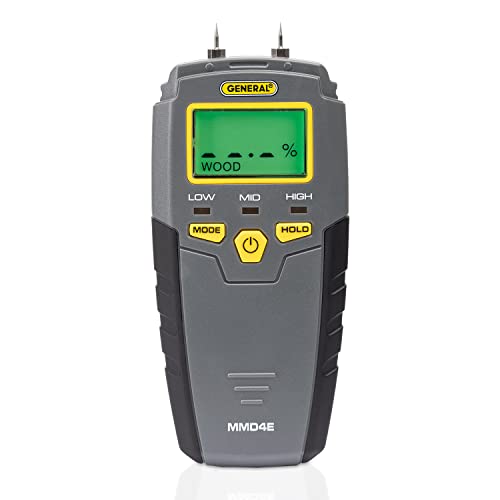
This pin-type meter offers a backlit LCD with large digits and audible/visual High‑Medium‑Low moisture alerts. It includes extra stainless steel pins and a protective cap that doubles as a calibration checker. The meter also features a reading hold button for capturing results and a humidity sensor to detect damp areas linked to mold risk. For woodworking, it provides quick spot checks of boards, panels, and installed flooring to identify areas that require drying or further inspection.
PREXISO Wood Moisture Meter – 7 in 1

The PREXISO unit is a pin-type, multifunction tester with 2 precision pins and four measurement modes including single-point, multi-point averaging, and min/max. It also measures temperature and humidity, which helps determine equilibrium moisture content (EMC) expectations for your region. A color backlit LCD and hold function simplify readings when testing multiple boards or firewood. The ergonomic grip supports extended use in a workshop or lumberyard.
RDINSCOS Digital Moisture Meter

Designed for woodworking and inspections, this pin-type meter reads to approximately 12 mm depth and includes selectable settings tuned for different wood species with four modes. It offers an instant hold function for capturing precise readings and is positioned for users checking lumber moisture before joinery, glue-up, or installation. The device is also marketed for firewood moisture checks to avoid inefficient or smoky burns.
Lignomat Mini-Ligno MD/C Moisture Meter

The Lignomat Mini-Ligno MD/C is a professional-grade pin-type meter with built-in wood group corrections for softwoods, hardwoods, and panel products. Its measuring range (roughly 6–25%) matches common woodworking targets, making this tool suitable for flooring, cabinetry, and restoration tasks where accurate species-corrected readings matter. Durability and calibration pedigree are emphasized for shop and field use.
Povlen Pinless Moisture Meter

This pinless meter uses high-frequency waves for non-invasive moisture detection, protecting surfaces from pinholes and scratches. It offers density/softwood mode adjustments, an analog bar display, audible alerts and auto power-off. Pinless testing is useful for finished surfaces, veneered panels, or when repeated checks are needed across many boards without leaving marks. Depth of detection varies by model, so confirm the sensing depth relative to your material thickness.
Buying Guide: Choosing A Moisture Meter For Woodworking
Choosing the right moisture meter depends on the woodworking task, material types, and workflow. Below are key considerations and comparison perspectives to help match a meter to your needs.
1. Pin-Type Versus Pinless
- Pin-Type: Measures electrical resistance via inserted pins, offering deeper, species-corrected readings. Useful for exposed lumber, end-grain checks, and accurate %MC readings. Leaves small pinholes.
- Pinless: Uses sensors to scan a surface non-invasively. Faster for surface scanning and finished pieces; limited to surface/near-surface moisture and can be affected by dense finishes or thick veneers.
2. Measurement Range And Accuracy
- Select a meter with a measuring range that covers expected woodworking targets (typically 6–12% for kiln-dried hardwoods, 8–14% for many softwoods, higher for rough green wood).
- Pay attention to stated accuracy and error margin. Professional users often prefer units with species correction or selectable wood groups to reduce systematic bias.
3. Wood Species Correction And Modes
- Wood species differ in electrical properties; meters with built-in wood group settings or species selection improve reliability for hardwoods vs softwoods.
- Multi-mode meters (single, averaging, min/max) help when testing variable boards or stacks.
4. Depth Of Measurement
- Pin meters measure a finite depth determined by pin length; choose pin length appropriate for your thickness and whether you need surface vs internal readings.
- Pinless meters specify sensing depth (often a few millimeters to centimeters); ensure it matches your inspection needs.
5. Workflow And Handling
- Consider ergonomics, display readability (backlit LCD/helpful alerts), and features like hold functions for taking readings on vertical surfaces or ladders.
- Durability and included accessories (extra pins, protective caps, batteries) reduce downtime in a busy shop.
6. Use Cases: Which Meter For Which Task
- Lumber & Drying: Pin-type with species settings and ability to test end grain for internal moisture.
- Finished Surfaces & Veneers: Pinless to avoid surface damage and to quickly map moisture patterns.
- Flooring & Installation: Both types: pinless for broad scans, pin-type for targeted verification.
- Firewood & Heating: Pin-type or meters with modes for firewood to ensure safe, efficient burn moisture levels.
7. Calibration, Maintenance, And Limits
- Regular calibration according to manufacturer guidance maintains accuracy.
- Be aware of conditions that affect readings: temperature, saline contamination, finishes, adhesives, and composite materials.
- Use multiple readings across board faces and ends; average multiple measurements when assessing stacks.
8. Interpreting Moisture Content For Woodworking
- Target equilibrium moisture content (EMC) based on local relative humidity and expected in-service conditions; typical shop targets are 6–8% for fine furniture in controlled interiors, 8–12% for general interior construction, and higher for unconditioned spaces.
- Allow wood to acclimate to shop or installation environment before final machining or finishing. Use meter trends, not single readings, to assess stability.
Final Selection Tip: Match meter type to material and stage of work: choose a professional pin-type with wood group corrections for kiln-dried lumber and precision joinery, and a pinless scanner for finished surfaces and non-destructive checks.