Quick Summary: This guide reviews top jigsaw blades suited for cutting curves in wood, plywood, laminates, plastics, and some metals. Below is a compact comparison table of the selected blades to help you scan features at a glance.
| Product | Material Fit | Key Feature | Brand |
|---|---|---|---|
| 25Pack T101AO T-Shank Jigsaw Blades | Wood, PVC | High carbon steel, fine curved cuts | Rvetol |
| Festool S 75/1,4 K/5 Curve Cuts | Wood | Conically ground teeth for clean curves | Festool |
| Spyder 4-Inch Double Sided Blade | Laminates, plastics, softwoods | Patented double-sided design for extreme radii | Spyder |
| Lenox U-Shank Scroll Cutting Blade | Wood, flooring, patterns | Narrow profile for tight curves, precision ground | Lenox |
| Bosch T244D3 4″ 6 TPI T-Shank | Hard & soft wood, plywood | Fast curved cuts, 6 TPI for speed | BOSCH |
25Pack T101AO T-Shank Jigsaw Blades – 3.2 Inch 20 TPI

What It Is: A 25-piece set of T101AO T-shank blades sized for fine curved cuts. Each blade is 3.2 inches overall with a 2.2-inch cutting edge and 20 TPI.
Material Compatibility: Designed for softwood, hardwood, chipboard, fiber boards, plastic and plywood.
Notable Features: Made from high carbon steel (HCS) for wear tolerance and extended life. The blade profile and tooth count are aimed at clean, fine curved cuts in thinner stock and sheet goods.
Best Use Cases: Repeated curve cutting on wood and plastics where a fine edge and quantity are helpful for projects, templates, and pattern work.
Festool 204267 Jigsaw Blade S 75/1,4 K/5 For Curve Cuts

What It Is: A 5-pack of premium jigsaw blades from Festool intended specifically for cutting curves in wood.
Material Compatibility: Optimized for wood species—soft and hard—where surface finish matters.
Notable Features: Conically ground teeth create very clean curved cuts and reduce tear-out. Manufactured in Germany with attention to manufacturing tolerances and edge geometry.
Best Use Cases: Finish carpentry, cabinetry, and projects where the cut edge quality is a primary concern and minimal sanding is desired.
Spyder 300004 4-Inch Double Sided Jigsaw Blades

What It Is: A specialized double-sided jigsaw blade designed for cutting extreme radii and delicate materials.
Material Compatibility: Laminates, fiberboard, plastics, Corian, fiberglass, formica, and softwoods.
Notable Features: Patented double-sided design allows cutting tight radiuses from either direction with a clean finish. The geometry reduces binding when turning curves and helps maintain a consistent radius.
Best Use Cases: Decorative laminate work, rounded cutouts in countertops, and intricate pattern cutting where tight radii and edge quality are required.
LENOX U-Shank Scroll Cutting Jig Saw Blade – 3 1/2″ 20 TPI

What It Is: A scroll-cutting jigsaw blade with a narrow profile and precision-ground teeth for smooth curved cuts.
Material Compatibility: Commonly used on wood, including flooring materials and patterned cuts.
Notable Features: Narrow blade profile provides clearance for tight curves. Precision ground tooth angles help avoid burning and produce smoother scroll cuts. Intended for tasks like flooring installation and cutout patterns.
Best Use Cases: Tight radius scroll work in flooring, decorative wooden inlays, and pattern cutting where blade clearance matters.
Bosch T244D3 4″ 6 TPI T-Shank Jig Saw Blades
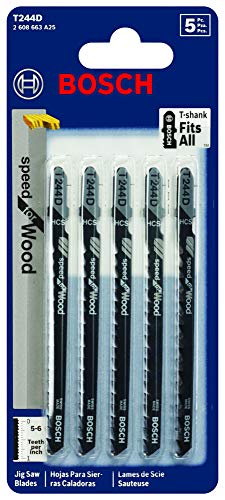
What It Is: A 5-piece set of 4-inch T-shank blades designed for curved and fast cuts in wood with a coarse 6 TPI profile.
Material Compatibility: Hard and soft wood, OSB, and plywood up to specified thickness ranges.
Notable Features: 6 TPI tooth pattern offers faster material removal and smooth performance in thicker stock. High carbon steel body balances cutting speed and blade life for curved routing through bulkier panels.
Best Use Cases: Rapid curve cutting where throughput is prioritized over the finest edge finish—larger radius cuts in thicker lumber and sheet goods.
Buying Guide: How To Choose Jigsaw Blades For Curves
Selecting the right blade for curved cuts requires assessing blade geometry, material compatibility, and the radius you need to achieve.
Blade Type And Shank
- T-Shank vs U-Shank: T-shank blades (most modern jigsaws) offer tool-free changes and stable clamping. U-shank blades fit older models; ensure compatibility with your saw.
- Specialty Blades: Scroll and double-sided blades are designed for very tight radii and intricate contours.
Tooth Count (TPI) And Cut Quality
- Low TPI (4–8): Faster cuts and ideal for thick wood and large radius curves; leaves rougher edges.
- Medium TPI (10–14): General-purpose balance for curved cuts in a variety of woods.
- High TPI (18–24+): Cleaner edges for veneers, laminates, and thin materials; slower cutting.
Blade Material And Coating
- HCS (High Carbon Steel): Best for wood and plastics—flexible and less brittle for curves.
- HSS (High Speed Steel): Suited for metal cutting and higher heat resistance; less flexible for tight curves.
- Carbide/TPI Treatments: Carbide-tipped or special coatings can extend life when cutting abrasive materials.
Blade Profile And Geometry
- Narrow Blades: Provide clearance for tight turns; essential for scroll work.
- Conical/Angled Teeth: Reduce tear-out and produce cleaner curved edges.
- Double-Sided Blades: Allow cutting extreme radii in either direction with consistent finish.
Cut Direction And Tooth Set
- Top-Set Teeth: Cut aggressively but may cause splintering on top surfaces.
- Ground/Conical Teeth: Designed for cleaner results on curved cuts—look for these when finish quality matters.
Durability And Quantity
- If you perform repetitive curve cutting, multi-packs or contractor sets offer value and reduce downtime.
- For one-off precision work, premium single-blade packs (conical ground or specialty brands) can save finishing time.
Practical Comparison Perspectives
- Finish vs Speed: Choose higher TPI and conical tooth geometry for cleaner edges; choose lower TPI for faster removal in thicker stock.
- Tight Radius vs Large Curves: Double-sided and narrow U-shank/scroll blades excel at tight radii; standard T101AO and T244D style blades are better for moderate radii.
- Material Mix: If you need to cut both laminates and wood, select blades rated for both or keep dedicated blades to preserve edge quality.
Tips For Best Results
- Use appropriate speed settings on your jigsaw: slower for fine finish blades, faster for coarse blades.
- Clamp workpiece and use guides/templates to reduce vibration and maintain curve accuracy.
- Make relief cuts when approaching tight internal corners to avoid binding.
- Swap to a finer-tooth blade near finish passes to reduce tear-out.