Quick Overview: Choosing the right hacksaw blade for stainless steel affects cut quality, blade life, and safety. The table below summarizes the five selected blades from Amazon chosen for stainless steel cutting performance, tooth pitch, material, and construction.
| Product | Brand | Key Feature |
|---|---|---|
| GRAFF 8% Cobalt Premium Hacksaw Blades 12 Inch | GRAFF | 8% cobalt bi‑metal, 24 TPI, durable for stainless |
| Starrett Bi‑Metal Safe‑Flex Hand Hacksaw Blade 12″ | Starrett | Patented bi‑metal process, high tooth strength, 24 TPI |
| Starrett Redstripe Solid HSS Power Hacksaw Blade 12″ | Starrett | Solid HSS, .050″ thickness, 10 TPI for high‑speed alloy cuts |
| HAUTMEC 12″ Hacksaw Blades 32 TPI – 10 Pack | HAUTMEC | Bi‑metal, 32 TPI fine pitch for precise hard‑material cuts |
| JUGREAT Hacksaw Replacement Blades 12″ 24 TPI (10 Pack) | JUGREAT | High‑speed steel teeth, 24 TPI, multi‑material |
GRAFF 8% Cobalt Premium Hacksaw Blades 12 Inch
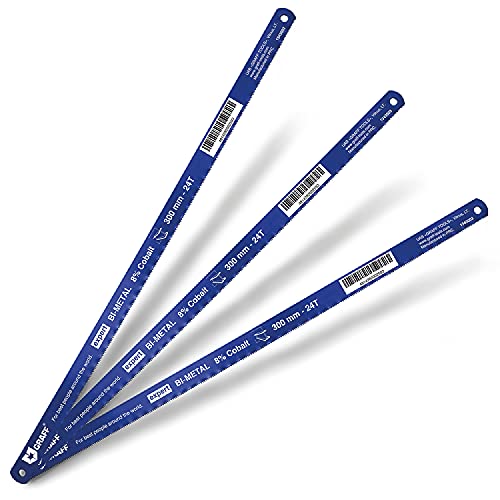
Key Features: Designed for fast, precise metal cutting; 8% cobalt content for abrasion resistance; 12″ (300mm) length suitable for stainless steel; 24 TPI tooth pitch; increased flexibility and durability.
This blade targets stainless steel work with a high‑alloy tooth composition that resists heat and wear. The 24 TPI balance provides good control and a reasonably smooth finish on thinner stainless sections. The bi‑metal construction and claimed flexibility reduce the chance of catastrophic breakage when twisting or bending occurs during interrupted cuts.
Starrett Bi‑Metal Safe‑Flex Hand Hacksaw Blade 12″

Key Features: Patented solid state diffusion bi‑metal, enhanced tooth strength, designed for interrupted cuts, 12″ length, 24 TPI, packaged as a 2‑pack.
Starrett’s patented bi‑metal manufacturing increases tooth resilience and reduces breakage, which is useful when cutting stainless where teeth can dull quickly. The Safe‑Flex design tolerates twisting stresses, making it suitable for cramped or awkward cuts. The 24 TPI is appropriate for many stainless tasks where a balance of speed and finish is needed.
Starrett Redstripe Solid HSS Power Hacksaw Blade 12″

Key Features: Solid high‑speed steel construction, .050″ thickness, 10 TPI, built for high cutting speed and heavy feed pressure, effective on tough alloys including stainless.
Solid HSS blades deliver sustained cutting through thicker or tougher stainless pieces where tooth shear strength and heat resistance are critical. The lower 10 TPI gives faster material removal and reduces clogging when cutting thicker stock, but yields a rougher finish and is best for larger‑section stainless or steel where speed matters more than edge smoothness.
HAUTMEC 12″ Hacksaw Blades 32 TPI – 10 Pack

Key Features: Bi‑metal construction with high‑speed steel teeth and spring steel body, 32 TPI fine pitch, standard 12″ length, universal fit to most frames.
High TPI (32) is optimized for clean, precise cuts on hard materials like thin stainless tubing or sheet where tooth engagement is small. The spring steel body offers flexibility while HSS teeth maintain cutting edge. These blades are particularly useful for tasks requiring a smooth finish or when cutting thinner stainless parts that are prone to snagging with coarser blades.
JUGREAT Hacksaw Replacement Blades (10 Pack) High Speed 24 TPI

Key Features: 12″ length, 24 TPI, bi‑metal with high‑speed steel teeth, wavy set teeth pattern, multi‑material capability including steel and piping.
The 24 TPI high‑speed teeth and wavy set pattern provide an effective compromise for stainless cutting—reasonable cut rate with adequate chip clearance and a smoother finish than low‑TPI blades. A 10‑pack supports repeated jobs or replacement needs for a busy shop. These blades are marketed as professional grade for varied materials.
Buying Guide: How To Choose Hacksaw Blades For Stainless Steel
Blade Material: Bi‑metal blades pair a flexible spring steel body with HSS teeth and are generally best for stainless steel. Solid HSS blades offer exceptional wear resistance and heat tolerance for heavy or continuous cutting.
Tooth Pitch (TPI): Match TPI to material thickness. 32–24 TPI for thin stainless or sheet for cleaner cuts; 24 TPI for general stainless tubing and bars; 10–14 TPI for thick stainless stock where faster removal is required.
Tooth Design: Wavy set teeth help with chip clearance; fine pitches reduce vibration and snatch. For interrupted cuts or twisted access, blades with enhanced tooth bonding (bi‑metal diffusion or high cobalt content) resist breakage.
Thickness & Width: Thicker blades (.050″) resist bending during heavy feed but are less suitable for tight curves. Standard 1/2″ width fits most frames; wider blades may be used in power hacksaws.
Cobalt & Alloying: Blades with cobalt or special HSS formulas increase abrasion resistance and high‑temperature hardness, extending life when cutting stainless.
Frame Compatibility: Ensure 12″ (300mm) blades and standard width match your hacksaw frame. Universal fit blades are convenient for most hand frames.
Cutting Application: For precision trim or thin work choose high TPI bi‑metal blades. For heavy fabrication and thick sections choose solid HSS or low‑TPI blades. Consider reciprocating vs hand hacksaw—some blades are optimized for one application.
Durability vs Finish: Higher tooth strength and HSS composition prioritize longevity and cutting speed. Fine tooth counts and bi‑metal designs prioritize finish and control. Balance your priority between finish and blade life.
Pack Size & Replacement Frequency: Buying multi‑packs is economical for frequent use. Inspect blades for wear, keep them sharp, and replace if teeth are rounded or cutting becomes difficult.
Safety Tips: Use secure clamping, steady feed, and appropriate lubrication or cutting fluid for stainless to reduce heat and prolong blade life. Wear eye protection and gloves.