Choosing the right end mill for aluminum can dramatically improve surface finish, tool life, and cutting efficiency. This article highlights five top-performing carbide and high-speed steel options designed for aluminum workpieces, including coatings that boost hardness and heat resistance. Each pick is evaluated for aluminum-friendly applications like milling, slotting, and complex contouring.
| Product | Brand |
|---|---|
| SpeTool 3 Flute Carbide End Mill for Aluminum | SpeTool |
| SPEED TIGER EISE 1/2″ Carbide Square End Mill | SPEED TIGER |
| WEXWE Tools DLC Series Carbide End Mill | WEXWE |
| BestParts Solid Carbide End Mill for Aluminum | BestParts |
| SPEED TIGER Carbide Square End Mill (IAUE3/8) | SPEED TIGER |
SpeTool 3 Flute Carbide End Mill for Aluminum

Solid carbide end mill with a 3/8 inch shank and a 3/8 inch cutting diameter, designed for aluminum and non-ferrous metals. Features include a 1-1/2 inch cutting length and 3-1/2 inch total length, with an upcut design that promotes easy chip removal and a smooth surface finish. The tool is optimized for aluminum 6061 and 7075 alloys, offering long service life and reliable performance in non-ferrous machining tasks.
SPEED TIGER EISE 1/2″ Carbide Square End Mill

1/2″ carbide square end mill with AlTiN coating for enhanced hot hardness and oxidation resistance. Made from micrograin carbide for improved toughness and durability, suitable for aluminum, copper, and various alloys. The coating and material properties support higher-speed cutting and extended tool life in challenging aluminum machining operations.
WEXWE Tools DLC Series Carbide End Mill
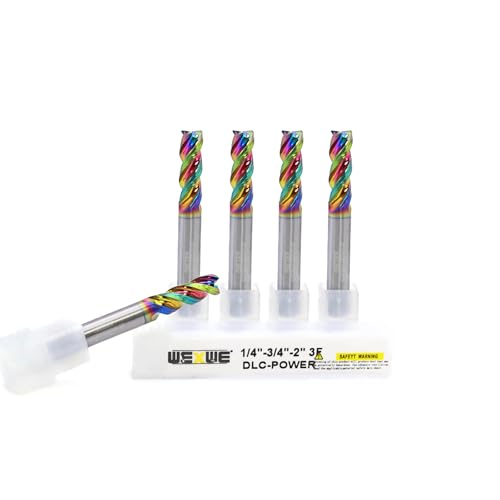
Diamond-Like Coating (DLC) carbide end mills designed for aluminum and other light metals. Features include HV7000 surface hardness, low friction, and strong adhesion resistance. The tooling is built from ultrafine grain tungsten carbide to provide high cutting efficiency, wear resistance, and stability during high-speed operations on aluminum workpieces.
BestParts High Performance Solid Carbide End Mill for Aluminum

Featuring a 5/16″ cutting diameter with a 37° helix and ZRN coating, this solid carbide end mill is optimized for aluminum. The tool’s coating enhances wear resistance and heat tolerance, enabling faster chip removal and longer tool life when machining harder aluminum alloys and high-temperature applications.
SPEED TIGER Carbide Square End Mill (IAUE3/8)

Three-flute carbide square end mill designed for aluminum with a high-feed U-type design for roughing and finishing. The tool emphasizes rapid material removal (MRR) and surface smoothness, making it suitable for challenging aluminum applications and consistent performance in high-speed milling.
Buying Guide: Key Considerations For Aluminum Milling
- Material and coating: Carbide end mills with AlTiN or DLC coatings provide superior hardness, heat resistance, and wear protection when cutting aluminum to extend tool life and maintain edge quality across passes.
- Tool geometry: A 2- or 3-flute design can balance chip evacuation and rigidity for aluminum. Upcut or compression geometry typically yields better chip removal and surface finish in aluminum alloys.
- Shank and diameter: Match the shank size to your machine collet and spindle. Smaller diameters excel at detail work; larger diameters remove material quickly but demand sturdier setups.
- Coating and substrate: Solid carbide tools excel in high-speed aluminum milling, while HSS variants may be cost-effective for light-duty work or prototyping. Coatings reduce wear and prevent built-up edges on aluminum.
- Machining parameters: Aluminum machines best with high feed rates, moderate spindle speeds, and proper lubrication or flooding to manage heat and surface finish. Start with conservative speeds and adjust based on sound, vibration, and chip formation.
- Application range: Consider whether your tasks require roughing, finishing, slotting, or contouring. Choose a geometry and coating that aligns with the intended operation and desired surface quality.
- Compatibility and safety: Ensure tooling is compatible with your CNC controller and tool-holder system. Use appropriate clamping and chip-control strategies to avoid workpiece movement and ensure operator safety.