Choose the right blade for clean, chip-free cuts in particle board by matching blade type, tooth count, kerf, and arbor to your saw and project. Below is a quick comparison of selected blades to help you pick a blade that minimizes tear-out and improves finish when working with particle board and related sheet goods.
| Product | Key Feature | Best For |
|---|---|---|
| WEN BL0704 7-1/4″ PCD Blade | Ultra-thin 1/15″ kerf, PCD tips | Hard fiber cement & laminate; long life |
| Diablo HardieBlade 7-1/4″ PCD | PCD triple chip, James Hardie approved | Heavy-duty fiber cement; low dust |
| FOXBC 4-1/2″ 120T Trim Blades (3-Pack) | High tooth count for smooth edges | Small trim saw, fine crosscuts in plywood & panels |
| Revvstark 5-1/2″ TCT Blades (24T & 48T) | Carbide tipped, thin kerf options | Compact saws for wood, particle board, plastics |
| KURSTOL 10″ 80T ABT Blade | High tooth count, 1.8mm thickness | Large table saw or circular saw cuts in particle board |
WEN BL0704 7-1/4-Inch 4-Tooth Diamond-Tipped (PCD) Blade
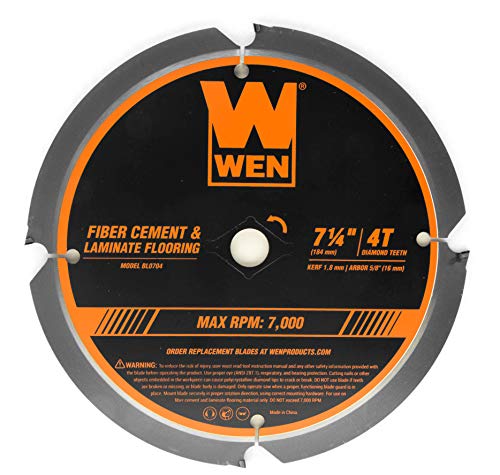
This PCD-tipped blade is built for extremely abrasive materials, featuring a 7-1/4-inch diameter, 5/8-inch arbor, and up to 7000 RPM rating. The ultra-thin 1/15-inch kerf reduces material waste and improves cut efficiency. While optimized for fiber cement and laminate flooring, its thin kerf and diamond-tipped teeth make it suitable for cleanly slicing particle board when minimizing tear-out is important. The low tooth count (4T) emphasizes longevity and aggressive material removal over ultra-fine finish.
Diablo HardieBlade 7-1/4″ x 4T PCD Tipped
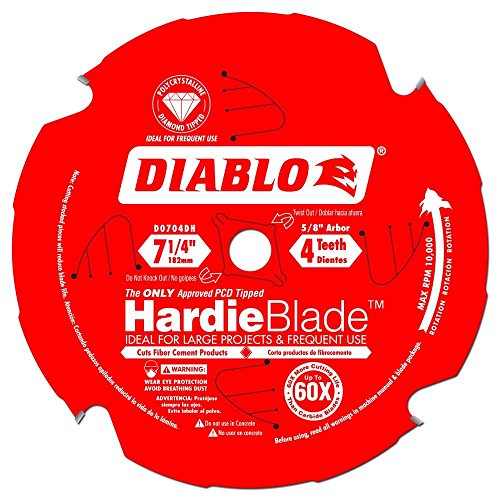
The Diablo HardieBlade uses a PCD triple chip design for extended life—claimed up to dozens of times longer than carbide—making it suitable where durability is critical. It also produces less respirable dust, which can benefit indoor cutting of particle board and composites. The 4-tooth layout prioritizes durability for heavy cuts; for particle board projects where smooth finishes matter, pair this with a backing support (cutting on a sacrificial board) to reduce edge chipping.
FOXBC 4-1/2″ 120 Tooth Trim Blades (3 Pack)

These high-tooth-count (120T) trim blades are designed for small circular or trim saws with a 3/8-inch arbor. The dense tooth pattern gives very smooth crosscuts and reduces splintering on thin panels and particle board. They are best for finish trimming, plunge cuts, and where a clean face edge is required. Their small diameter makes them ideal for handheld trim saws or compact tools rather than full-size circular saws.
Revvstark 5-1/2″ Carbide Tipped Blades 24T & 48T

Available in 24T and 48T configurations for compact saws with a 10mm arbor, these carbide-tipped blades balance aggressive cutting and finish quality. The thin laser-cut kerf reduces material tear and improves speed. Choose 48T for smoother crosscuts on particle board and veneered panels, or 24T for faster rip cuts. The construction-grade tungsten carbide teeth resist heat and abrasion in prolonged use.
KURSTOL 10″ 80T ABT Wood Cutting Blade
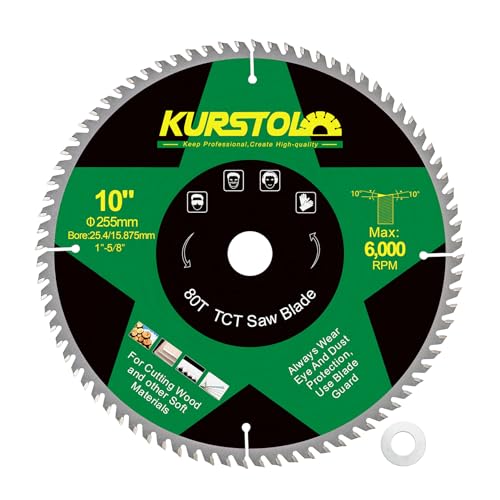
This 10-inch, 80T ABT blade is targeted at larger saws for table saw or circular saw use. The 80 teeth and alternating bevel/triple-chip style help produce a very smooth finish on particle board, laminated panels, and plywood. At a listed 1.8mm blade thickness, it offers a good balance between rigidity and a thin kerf for reduced tear-out. Use this blade for long rip or crosscut runs where efficiency and clean faces are priorities.
Buying Guide: Choosing A Blade For Particle Board
Particle board is prone to tear-out and chipping, especially on the exposed face. Choose blades that reduce splintering and produce a cleaner edge.
Blade Type
- High tooth count (40–80+ T) — Better finish on crosscuts and veneered particle board.
- Fine trim blades (80–120 T on small diameters) — Ideal for handheld trim saws for edge work.
- PCD or diamond-tipped — Extremely durable for abrasive composite materials; can be overkill for basic particle board but useful in heavy production environments.
- Carbide tipped — Standard choice balancing cost and life for wood composites.
Kerf And Tooth Geometry
- Thin kerf (1.8mm or less) cuts with less tear-out and reduces waste; requires a stable saw to avoid deflection.
- ATB (Alternating Top Bevel) — Produces clean edges on laminates and veneered particle board.
- Triple-Chip Grind (TCG) — Durable and good for abrasive or coated panels.
Arbor And Compatibility
- Match the blade arbor to your saw (5/8″, 1″, 10mm, 3/8″ etc.).
- Adapters can be used but ensure safe mounting and correct runout tolerances.
Tooth Count vs. Cut Type
- Low tooth count (4–24T) — Faster cuts and longer life, rougher finish.
- Medium tooth count (40–60T) — Good balance for rip and crosscuts on particle board.
- High tooth count (80–120T) — Best finish; slower feed rate and higher heat build-up risk.
Dust And Health Considerations
- Cutting particle board creates fine dust; use dust collection and appropriate respiratory protection.
- Some specialty blades claim reduced respirable dust—consider for indoor or repeated work.
Tool Size And Application
- Use smaller diameter, high-tooth blades for trim saws and handheld finishing tasks.
- Use larger, higher-tooth blades (80T) on table saws or full-size circular saws for long, clean cuts.
Durability And Cost Considerations
- PCD tips and TCG designs last longer but cost more; choose when abrasive materials or high-volume cutting justify the investment.
- Carbide-tipped blades are typically cost-effective for most DIY and professional particle board work.
Cutting Technique Tips
- Score the cut line or use a sacrificial backer board to prevent blowout on the exit face.
- Set blade height correctly—about 1/8″ above the material for clean cuts.
- Use slow, steady feed rates for high-tooth blades to minimize heat and splintering.