Choosing the right blade for oriented strand board (OSB) means balancing tooth count, kerf, material, and arbor fit for cleaner cuts and less tear-out. Below is a quick comparison of five top blades suitable for OSB and similar sheet goods.
| Product | Size / Teeth | Key Features | Best For |
|---|---|---|---|
| CRAFTSMAN 7-1/4 Inch 140 Tooth | 7-1/4″ / 140T | Hardened plate, precision-ground teeth, high carbon steel | Fine finish cuts, circular saws with 7-1/4″ arbor |
| FOXBC 7-1/4 Inch 140 Tooth | 7-1/4″ / 140T | 140T, 0.086″ kerf, 5/8″ diamond arbor | Fine finish, reduced splintering on panel goods |
| FOXBC 6-1/2 Inch 140 Tooth | 6-1/2″ / 140T | 140T, 0.08″ kerf, diamond knockout | Compact saws, trim-style circular saws |
| FOXBC 5-1/2 Inch 130 Tooth (3-Pack) | 5-1/2″ / 130T | Includes bushings, high tooth count for smooth cuts | Trim saws, miter crosscuts in plywood/OSB |
| Janchi 5-1/2 Inch 130T (3-Pack) | 5-1/2″ / 130T | Precision ground teeth, tougher alloy steel | Frequent cutting of panel goods with thin kerf |
CRAFTSMAN 7-1/4 Inch 140 Tooth Fine Finish Carbon Circular Saw Blade

This 7-1/4″ 140-tooth blade is designed for fine finish cutting on plywood, OSB, and plastic. The fully hardened plate helps the blade maintain true cuts during extended use. Precision-ground teeth promote smoother, accurate cuts and the heavy-gauge high carbon steel construction aims to extend blade life. It suits full-size circular saws that accept 7-1/4″ blades and prioritize minimal tear-out on panel materials.
FOXBC 7-1/4 Inch 140 Tooth Fine Finish Carbon Circular Saw Blade
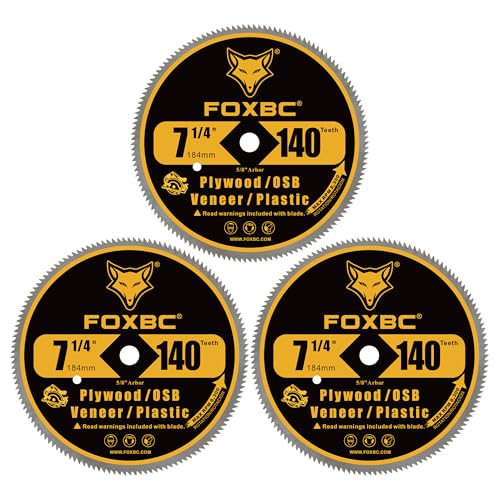
The FOXBC 7-1/4″ blade features 140 teeth and a 0.086″ kerf for smooth crosscuts and reduced splintering on veneers, plywood, and OSB. It includes a 5/8″ diamond arbor knockout for compatibility with most circular saw spindles. Offered as a 3-pack, this option targets users who frequently replace blades or need backups for jobsite use. Designed for clean finish cuts rather than heavy ripping.
FOXBC 6-1/2 Inch 140 Tooth Circular Saw Blade

This 6-1/2″ 140T blade is sized for compact or trim circular saws and offers a thin 0.08″ kerf. The diamond arbor knockout provides standard fit options. Its high tooth count is intended to minimize splintering and produce smooth miter edges on plywood, OSB, and similar sheet goods. Best suited for crosscuts and finish work on smaller portable saws.
FOXBC 5-1/2-Inch 130 Tooth Plywood, Veneer, OSB Cutting Blade (3 Pack)

This 5-1/2″ blade set includes 130 teeth and comes with 5/8″ arbor plus 1/2″ and 3/8″ bushings for broader compatibility. The high tooth density and thin kerf produce fast, smooth cuts on plywood, OSB, vinyl siding, and paneling. Packs of three are convenient for professionals or hobbyists who need replacements. The blade is optimized for trim and miter saws with smaller diameters.
3Pack 5-1/2 Inch 130T Circular Saw Blade By Janchi

The Janchi 5-1/2″ 130-tooth blades emphasize precision-ground teeth and a thin kerf for clean, accurate cuts in plywood, OSB, and paneling. Constructed from tougher alloy steel designed to retain sharpness, these blades come in a 3-pack and include bushings for multiple arbor fits. This option focuses on maintaining edge life while delivering smooth crosscuts on sheet goods.
Buying Guide: How To Choose A Circular Saw Blade For OSB
Tooth Count And Cut Quality: Higher tooth counts (80–140T) deliver smoother crosscuts with less tear-out. For OSB and plywood where edge finish matters, choose blades with 100+ teeth for trim saws and 140T for full-size saws to reduce splintering.
Kerf Thickness: Thin kerf blades (around 0.08″–0.09″) remove less material, reduce power draw, and minimize waste. Thin kerfs are preferred for battery-powered saws and thin sheet goods, but very thin kerfs can flex under heavy loads.
Blade Material And Heat Resistance: High carbon steel plates provide durability, while carbide-tipped teeth hold edges longer. For frequent cuts and prolonged heat exposure, carbide tips extend blade life and maintain precision.
Plate Hardening And Stabilization: Blades with fully hardened plates or heat-treated bodies resist warping and maintain trueness during extended cuts. This improves accuracy on long rip or cross-cuts in OSB panels.
Arbor Compatibility And Bushings: Confirm your saw’s arbor size (common: 5/8″, 1/2″, 3/8″) and look for blades with knockouts or included bushings to fit multiple spindles. Incorrect arbor fit affects runout and cut quality.
Intended Cut Type: Distinguish between blades optimized for crosscut/finish work (high T, fine tooth geometry) and ripping (fewer teeth, larger gullets). For OSB where finish is important, prioritize finish or combination blades with a higher tooth count.
Kerf And Tooth Geometry For Panel Goods: Tooth shape and hook angle influence chip removal and tear-out. Alternate top bevel (ATB) or triple-chip grind (TCG) are common for laminate, veneer, and composite panels to reduce chipping.
Pack Size And Replacement Strategy: Packs of multiple blades offer convenience and value for jobsite use. If you cut OSB routinely, keeping spares extends uptime and maintains consistent cut quality.
Compatibility With Saw Power: Match blade diameter and kerf to your saw’s horsepower. Thin-kerf, high-tooth blades on low-power saws are efficient; heavy-duty ripping blades need more motor torque.
Comparison Perspectives:
- Performance: High-tooth carbide-tipped blades produce superior finish on OSB vs. basic carbon blades.
- Durability: Carbide and hardened plates outlast plain high-carbon blades when cutting abrasive materials.
- Cost vs. Frequency: Multi-packs reduce per-blade replacement overhead for frequent users.
- Fit And Convenience: Blades with bushings/knockouts reduce compatibility issues across different saws.