Quick Overview: This guide compares popular card scrapers, curved cabinet cards, and burnishers ideal for achieving fine wood finishes. Below is a compact summary table of the five selected products reviewed in this article.
| Product | Type | Key Feature |
|---|---|---|
| DFM Tool Works Rectangle Card Scraper (2 Pack) | Rectangle Scrapers | 0.032″ high carbon steel, 5″ length, made in USA |
| DFM Tool Works Blue Curved Cabinet Scraper Cards (Set of 3) | Curved Scrapers | 0.032″ blue spring steel, curved profiles for contours |
| Fulton Cabinet Scraper Burnisher With 6-Piece Scraper Set | Burnisher + Multi-Shaped Cards | HRC 62-64 burnisher rod, six scraper shapes |
| Bueyfolt Cabinet Scraper Set | Mixed Shape Scrapers | Five-piece set: rectangle, curved, gooseneck, concave & convex |
| DFM Tool Works Curved Cabinet Scraper Cards – Juice Groove | Curved/CNC-cut Scrapers | CNC-cut edges, 50 C Rockwell high carbon steel |
DFM Tool Works Rectangle Card Scraper – Precision Cabinet Multi-use Scraper

This two-piece rectangle scraper set is sized at 0.032″ thickness, 2.5″ width and 5″ length. Constructed from high carbon steel with ~50 C Rockwell hardness, it targets longevity and edge retention. Each edge is pre-filed smooth for easier sharpening and burnishing, reducing setup time. The rectangular shape is versatile for flat surfaces and general smoothing, while the pair provides backup or different edge preparations. This set suits both beginners who need reliable, ready-to-burnish blades and experienced finishers who prefer consistent steel specs for repeatable results.
DFM Tool Works Blue Curved Cabinet Scraper Cards (Set Of 3)
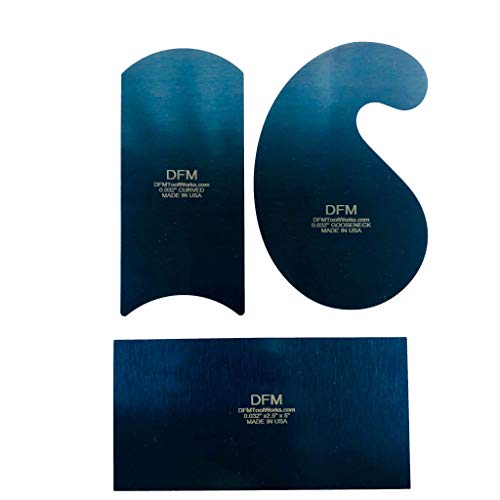
This set includes three curved profiles made from 0.032″ American Blue Spring Steel with a claimed 50 C Rockwell hardness. The curved cards are designed for cabinet work, contours, and edges where a flat scraper would be awkward. They recommend pairing with a burnisher for best performance. CNC consistency and the blue spring steel help maintain edge geometry after multiple burrs are formed. These are useful when working on chair parts, moldings, or any profile requiring a conforming scraping surface.
Fulton Cabinet Scraper Burnisher With 6-Piece Multi-Shaped Card Scraper Set

This kit pairs a hardened burnisher rod (HRC 62-64) with six different scraper shapes: three rectangles, one beveled, one curved (convex/concave), and one gooseneck. The burnisher rod diameter (~3/8″) and polished hard carbon steel allow strong, repeatable burr formation on flat or contoured scrapers. The variety of scraper shapes addresses diverse tasks from flat panels to spindles and carvings. The hardwood handle on the burnisher provides leverage and comfort while creating edges on varying profiles.
Bueyfolt Cabinet Scraper Set – Carbon Steel Scraper Cards

This five-piece set offers a mix of shapes: rectangle, curved, gooseneck, concave and convex. Designed for surface leveling and removing burrs and imperfections, this selection provides options for both flat panels and complex profiles. The set focuses on general-purpose finishing tasks where choosing the correct scraper shape improves contact and control. It’s positioned as a straightforward multi-shape starter set for woodworkers needing adaptability without buying individual blades.
DFM Tool Works Curved Cabinet Scraper Cards – Juice Groove

These curved cards are CNC-cut and feature a high carbon steel edge at ~50 C Rockwell. CNC cutting creates consistent edge geometry for immediate use, reducing initial filing or squaring. The “juice groove” and curvature are tailored for tight profiles and groove cleaning where precise edge contact matters. The emphasis is on efficiency for cabinetmakers and finishers who need predictable, ready-to-burnish scrapers for repetitive tasks.
Buying Guide: How To Choose The Right Card Scraper For Woodworking
Card scrapers and burnishers are simple tools that deliver refined finishes when chosen and used correctly. Below are the core considerations to evaluate before buying.
Steel Type And Hardness
- High Carbon Or Blue Spring Steel: Common choices for scraper cards; these steels take and hold a burr well. Look for stated Rockwell hardness to gauge edge retention.
- Burnisher Hardness: Burnishers should be harder than scrapers (HRC 62+ recommended) to form a consistent burr without deforming the tool.
Thickness And Size
- Thickness (~0.032″): Common for general-purpose scrapers; thinner cards flex more for curves, thicker cards resist chatter on large flat areas.
- Length & Width: Longer cards give more usable edge and heat dissipation; width affects grip and available edge length for burnishing.
Shape Selection
- Rectangle: Best for flat surfaces and edges.
- Curved/Convex/Concave: Required for molding, chair parts, and contoured work.
- Gooseneck/Beveled: Useful for tight profiles and inside curves where straight cards can’t reach.
Pre-Finished Edges Vs. DIY Preparation
- CNC-Cut Or Pre-Filed Edges: Reduces setup time—ideal for those who want to immediately form a burr.
- Unfinished Blades: Allow customization of edge geometry but require filing and squaring before burnishing.
Burnisher Compatibility And Ergonomics
- Rod Diameter & Shape: Smaller diameters are better for tight burrs on thin edges; larger rods provide leverage for long runs.
- Handle Comfort: Hardwood or ergonomic handles give better control and reduce fatigue during extended burnishing sessions.
Application And Workflow
- Fine Finishing: Scrapers excel at removing raised grain and producing ultra-smooth surfaces with minimal sanding.
- Restoration & Detail Work: Select varied shapes for profiles and small parts; use gooseneck and curved blades for spindles and moldings.
- Production Use: Choose durable steels and pre-cut edges for consistent repeatability and less setup time.
Maintenance And Edge Care
- Edge Sharpening: File and square the edge before burnishing; maintain a flat reference face for consistent burr formation.
- Burr Creation: Use a hardened burnisher and consistent pressure; test on scrap to set burr height and angle.
- Storage: Keep scrapers dry and separate from other tools to avoid nicks and rust on high-carbon steel.
Comparison Perspectives
- Beginner vs. Pro: Beginners benefit from CNC-cut or pre-filed scrapers and a solid burnisher; pros may prefer raw blades to set custom edge geometry.
- Flat Work vs. Contours: Flat-focused work prioritizes rectangles and thicker cards; contour work prioritizes multiple curved profiles and gooseneck shapes.
- Single Tool vs. Sets: Single high-quality scrapers are fine for dedicated tasks; sets give flexibility for mixed projects and are helpful in restoration or upholstery-adjacent work.