Quick Overview: This guide compares portable and stationary band saws and replacement blades useful for cutting metal. The table below summarizes the five featured products chosen for their metal-cutting capabilities and relevance to metalworking tasks.
| Product | Brand | Key Feature |
|---|---|---|
| VEVOR Portable Band Saw | VEVOR | 5″ cutting capacity, variable speed, removable base |
| PowerSmart Portable Band Saw | PowerSmart | 10A motor, 5″ depth, rotatable base 0–45° |
| WEN Metal Band Saw With Stand (BA4664) | WEN | Vertical/horizontal operation, selectable blade speeds |
| KFMK Variable Speed Metal Band Saw | KFMK | Dual workbench, 5″ capacity, adjustable 137–472 FPM |
| Imachinist M42 Bi-Metal Band Saw Blades (93″) | Imachinist | Bi-metal M42 blades, 10/14 TPI for thin tubing and pipe |
VEVOR Portable Band Saw, 110V Removable Alloy Steel Base

The VEVOR Portable Band Saw is a handheld, corded unit with a 10 amp (1100W) motor and a variable cutting speed range of 137.8–472.4 ft/min. It lists a 5″ round stock capacity (4.7″ rectangular without base). The removable alloy steel base reduces the cutting capacity slightly but adds stability and angle capability.
Features include an ergonomic soft-grip handle, adjustable blade guard to reduce jamming, and a design focused on balance for accurate cuts. The spec sheet emphasizes reduced sparks and burrs during metal cutting, and the motor uses a pure copper wind for durability.
PowerSmart Portable Band Saw With Removable Base

PowerSmart offers a 10 amp, 1100W motor portable band saw with a claimed 5″ cutting depth suitable for round or rectangular stock. The removable alloy steel base is rotatable from 0–45°, enabling angled cuts and improved setup flexibility.
The product lists advantages for metal cutting with low noise and minimal burrs. It weighs about 30 lbs including the base, promoting portability for jobsite or shop tasks. The base is described as easy to remove for hand-held operation.
WEN Metal Band Saw With Stand (BA4664)
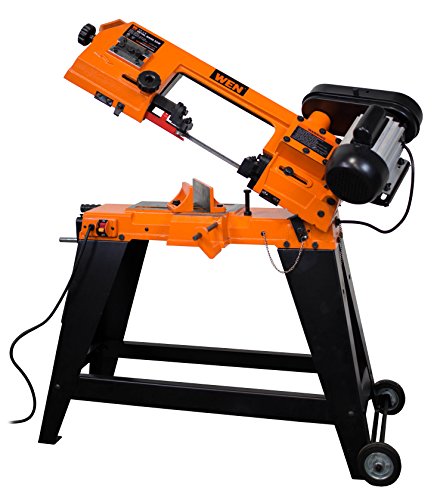
The WEN BA4664 is a bench/stand band saw that supports both vertical and horizontal cutting positions, expanding its versatility for different metal tasks. It lists selectable blade speeds of 80, 120, or 200 ft/min, which helps match blade speed to material type.
An automatic shut-off feature is noted to stop the saw after a cut completes, and the variable orientation supports a wider range of metalworking operations compared with handheld saws. This model targets shop setups where positional flexibility and controlled feed are priorities.
KFMK 10A Variable Speed Metal Band Saw With Large Workbench

The KFMK band saw lists a 10 amp motor with a 5-inch cutting capacity and an adjustable speed range of 137–472 FPM. It includes a large workbench for stable cutting of bigger stock and a small precision bench for detailed work.
The combination of dual workbench surfaces and broad speed adjustment suggests suitability for both heavy cuts and small, precise metal operations. The listing highlights adaptability to different materials by changing speed and using appropriate blades.
Imachinist S933414 M42 93″ Bi-Metal Band Saw Blades

This Imachinist blade is a bi-metal M42 blade sized 93″ x 3/4″ x 0.035″ with 10/14 TPI. It’s specified for cutting soft ferrous metals and is noted as suitable for thin pipe and tube profiles. Bi-metal M42 construction provides a harder tooth edge with a flexible backing for longer life during metal cutting.
Blade choice affects cut quality, speed, and tool life. The 10/14 TPI tooth pitch is commonly recommended for thinner-walled tubing and thin sheets where a balance of feed rate and finish is needed.
Buying Guide: How To Choose A Bandsaw For Metal
Selecting the right bandsaw for metal depends on workflow, materials, and shop constraints. Below are key considerations to compare models and blades effectively.
Cutting Capacity And Orientation
- Cutting Depth And Width: Match the saw’s maximum round and rectangular capacity to the largest stock you plan to cut. Portable saws typically list 4–5″ capacities; shop saws may exceed this.
- Handheld Versus Stationary: Handheld portable band saws offer mobility for on-site cutting and pipe fitting. Stationary or bench models give more clamping and positional control for repeatable shop cuts.
Motor Power And Speed Range
- Amp/Watts: Higher amp motors (8–12A range for portable, higher for workshop machines) sustain cuts in harder alloys. Consider continuous-duty rated motors for heavy use.
- Variable Speed: Adjustable speeds or multiple speed settings let you match blade speed (FPM) to material—lower speeds for harder steels, higher speeds for aluminum and non-ferrous metals.
Blade Selection And Tooth Pitch
- Blade Material: Bi-metal (M42) blades offer durability and edge retention for many ferrous metals.
- Tooth Per Inch (TPI): Lower TPI (3–6) for thick stock; mid-range TPI (6–10) for general purpose; higher TPI (10–24) for thin wall tube, sheet, or delicate profiles. Match TPI to material thickness to avoid rubbing or tooth overload.
- Blade Width/Length Compatibility: Ensure replacement blades match your saw’s required dimensions.
Workholding And Base/Bench Features
- Removable Or Rotatable Base: Bases that rotate or detach convert between hand-held and bench use while enabling angle cuts.
- Integrated Workbench: Stationary saws with larger work tables provide support when cutting long or heavy stock and improve cut accuracy.
- Clamps And Vises: For repeatable and safe cuts, choose a saw with secure clamping or plan to add a vice or fixture.
Safety And Usability
- Blade Guards And Adjustability: Adjustable guards reduce exposed blade length and help prevent jamming.
- Ergonomics: Soft grips and balanced design reduce fatigue during handheld operation.
- Automatic Shutoff/Stop Features: Useful for preventing extended blade contact after a cut and for workshop safety.
Material Types And Application Match
- Non-Ferrous Metals: Use higher blade speed and appropriate tooth pitch for clean cuts in aluminum, brass, and copper.
- Ferrous And Hard Steels: Lower speeds and durable bi-metal blades with appropriate TPI reduce heat buildup and increase tool life.
- Pipe And Tubing: Select a blade and speed that handle thin-walled profiles to avoid deformation and ensure a continuous smooth cut.
Maintenance And Consumables
- Blade Stretch And Tracking: Regularly inspect blade tension and tracking to prevent broken teeth and inconsistent cuts.
- Replacement Blades: Keep compatible spare blades with varied TPI in your inventory for different tasks.
- Cooling/Lubrication: For some metals, use cutting fluid or appropriate coolant to reduce heat and prolong blade life when recommended.
Comparison Perspectives
- Portability vs. Shop Stability: Portable models (VEVOR, PowerSmart, WEN handheld) prioritize mobility; bench/stand units (WEN BA4664) offer greater control and table support.
- Speed Flexibility: Models with broad variable speed ranges (VEVOR, KFMK) handle more materials; fixed or discrete speeds suit typical shop workflows.
- Blade Compatibility: Verify blade length/width and tooth pitch compatibility; aftermarket blades like Imachinist and FOXBC provide options for specific cutting tasks.